Question
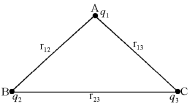
Write the definition of electrostatic at any point. Also write its S.I. units. As shown in the figure, three points charges $q_1$, $q _2$ and $q _3$ are placed at points $A, B$ and $C$ respectively. Drive an expression for the electrostatic potential energy of this system.
Image

Answer

Electrostatic Potential : "Electric potential at any point inside the electric field is equal to the ratio of the work W done in bringing a test positive charge from infinity to that point without acceleration and the value of the test charge $q_0$." The unit of electric potential in SI system is Volt. If charge $q_1$ is brought from infinity to $\vec{r}_1$, no work is done. Therefore $W _1=0$.
Work done in bringing charge $q _2$ from infinity to $\overrightarrow{r_2}$,
$ W_{12}=q_2, V_1=\frac{1}{4 \pi \varepsilon_0} \frac{q_1 q_2}{r_{12}} $
where the potential at distance $r_{12}$ is $V _1$.
Now charges $q_1$ and $q_2$ produce potential at the distance $\vec{r}_3$
$ V_3=\frac{1}{4 \pi \varepsilon_0} \cdot \frac{q_1}{r_{13}}+\frac{1}{4 \pi \varepsilon_0} \cdot \frac{q_2}{r_{23}} $
Work done in bringing the charge $q_{13}$ from infinity to $\overrightarrow{r_3}$,
$W ^{\prime}= W _{13}+ W _{23}=q_3 V_3$
$=q_3\left[\frac{1}{4 \pi \varepsilon_0} \cdot \frac{q_1}{r_{13}}+\frac{1}{4 \pi \varepsilon_0} \cdot \frac{q_2}{r_{23}}\right]$
$=\frac{1}{4 \pi \varepsilon_0} \frac{q_1 q_3}{r_{13}}+\frac{1}{4 \pi \varepsilon_0} \frac{q_2 q_3}{r_{23}}$
Therefore, the value of electrostatic potential energy of this system is
$U = W _{12}+ W ^{\prime}$
$=\frac{1}{4 \pi \varepsilon_0} \frac{q_1 q_2}{r_{12}}+\frac{1}{4 \pi \varepsilon_0} \frac{q_1 q_3}{r_{13}}+\frac{1}{4 \pi \varepsilon_0} \frac{q_2 q_3}{r_{23}}$
$=\frac{1}{4 \pi \varepsilon_0}\left(\frac{q_1 q_2}{r_{12}}+\frac{q_1 q_3}{r_{13}}+\frac{q_2 q_3}{r_{23}}\right)$

Need a full question paper?

Generate a complete, print-ready paper with questions like this in minutes — across 16+ boards, with answer keys.

Start Generating Free

Similar questions

A heavy particle is suspended by a 1.5m long string. It is given a horizontal velocity of $\sqrt{57}\text{m/s}.$
  1. Find the angle made by the string with the upward vertical, when it becomes slack.
  2. Find the speed of the particle at this instant.
  3. Find the maximum height reached by the particle over the point of suspension. Take g = 10m/s2.
A square plate of edge d and a circular disc of diameter d are placed touching each other at the midpoint of an edge of the plate as shown in figure. Locate the centre of mass of the combination, assuming same mass per unit area for the two plates.

Find the acceleration of the blocks A and B in the three situations shown in figure.


Use (i) the Ampere's law for H and (ii) continuity of lines of B, to conclude that inside a bar magnet, (a) lines of H run from the N pole to S pole, while (b) lines of B must run from the S pole to N pole.
In a series RC circuit with an AC source, $\text{R}=300\Omega,\text{C}=25\mu\text{F},\in_0=50\text{V}$ and $\nu=\frac{50}{\pi}\text{Hz}.$ Find the peak current and the average power dissipated in the circuit.
A rod of negligible heat cafacity has length 20cm, area of cross section 1.0cm and thermal conductivity 200Wm-1°C-1. The temperature of one end is maintained at 0°C and that of the other end is slowly and linearly varied from 0°C to 60°C in 10 minutes. Assuming no loss of heat through the sides, find the total heat transmitted through the rod in these 10 minutes.
A light beam of wavelength 400 run is incident on a metal plate of work function 2.2eV.
  1. A particular electron absorbs a photon and makes two collisions before coming out of the metal. Assuming that 10% of the extra energy is lost to the metal in each collision, find the kinetic energy of this electron as it comes out of the metal.
  2. Under the same assumptions, find the maximum number of collisions the electron can suffer before it becomes unable to come out of the metal.
A neutron initially at rest, decays into a proton, an electron and an antineutrino. The ejected electron has a momentum of 1.4 × 10⁻²⁶kg-m/s and the antineutrino 6.4 × 10⁻²⁷kg-m/s. Find the recoil speed of the proton:
  1. If the electron and the antineutrino are ejected along the same direction.
  2. If they are ejected along perpendicular directions. Mass of the proton = 1.67 × 10⁻²⁷kg.
A room has AC run for 5 hours a day at a voltage of 220V. The wiring of the room consists of Cu of 1mm radius and a length of 10m. Power consumption per day is 10 commercial units. What fraction of it goes in the joule heating in wires? What would happen if the wiring is made of aluminium of the same dimensions?
cu = 1.7 × 10⁻⁸Ωm , ρAl = 2.7 × 10-8 Ωm]
Suppose we want to verify the analogy between electrostatic and magnetostatic by an explicit experiment. Consider the motion of (i) electric dipole p in an electrostatic field E and (ii) magnetic dipole m in a magnetic field B. Write down a set of conditions on E, B, p, m so that the two motions are verified to be identical. (Assume identical initial conditions.)