Question
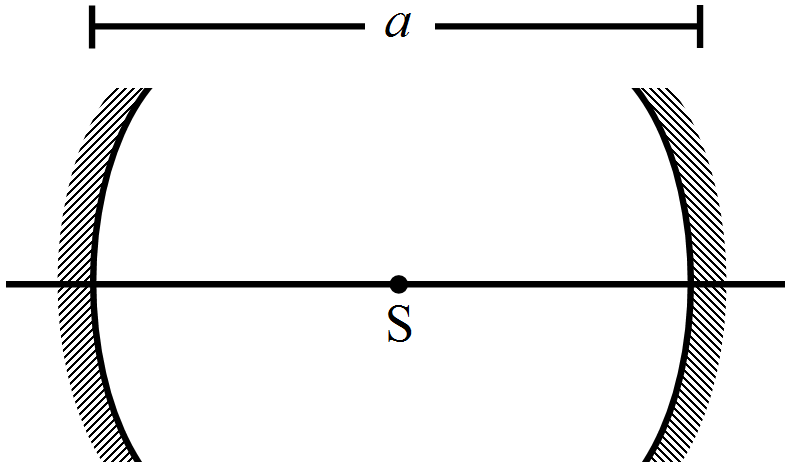
A point source S is placed midway between two converging mirrors having equal focal length f. Find the values of d for which only one image is formed.
Answer


Both the mirrors have equal focal length f.
They will produce one image under two conditions.
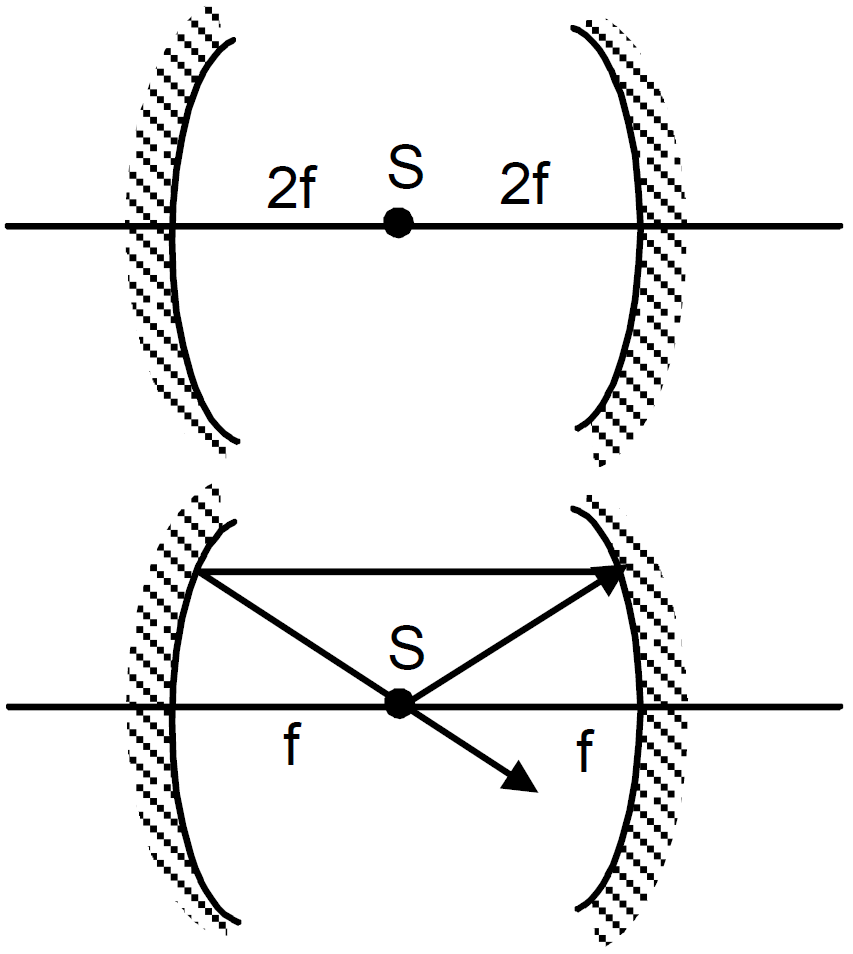
Case I: When the source is at distance ‘2f’ from each mirror i.e. the source is at centre of curvature of the mirrors, the image will be produced at the same point S. So, d = 2f + 2f = 4f.
Case II: When the source S is at distance ‘f’ from each mirror, the rays from the source after reflecting from one mirror will become parallel and so these parallel rays after the reflection from the other mirror the object itself. So, only sine image is formed.
Here, d = f + f = 2f

Need a full question paper?

Generate a complete, print-ready paper with questions like this in minutes — across 16+ boards, with answer keys.
Start Generating Free

Similar questions

A wave is described by the equation$\text{y}=(1.0\text{mm})\sin\pi\Big(\frac{\text{x}}{2.0\text{cm}}-\frac{\text{t}}{0.01\text{s}}\Big).$
  1. Find the time period and the wavelength.
  2. Write the equation for the velocity of the particles. Find the speed of the particle at x = 1.0cm at time t = 0.01s.
  3. What are the speeds of the particles at x = 3.0cm, 5.0cm and 7.0cm at t 0.01s?
  4. What are the speeds of the particles at x 1.0cm at t = 0.011, 0.012, and 0.013s?
A copper wire having resistance 0.01 ohm in each metre is used to wind a 400-turn solenoid of radius 1.0cm and length 20cm. Find the emf of a battery which when connected the solenoid will eauee a magnetic field of $1.0 \times 10^{-2}T$ near the centre of the solenoid.
A particle of mass m is kept on the top of a smooth sphere of radius R. It is given a sharp impulse which imparts it a horizontal speed v.
  1. Find the normal force between the sphere and the particle just after the impulse.
  2. What should be the minimum value of v for which the particle does not slip on the sphere?
  3. Assuming the velocity v to be half the minimum calculated in part.
  4. Find the angle made by the radius through the particle with the vertical when it leaves the sphere.
The bob of a pendulum at rest is given a sharp hit to impart a horizontal velocity $\sqrt{10\text{gl}},$ where l is the length of the pendulum. Find the tension in the string when,
  1. The string is horizontal.
  2. The bob is at its highest point.
  3. The string makes an angle of 60° with the upward vertical.
Calculate force pair required to deflect a bar magnet by $\theta^{\circ}$ in a uniform magnetic field and on this basis define magnetic moment and calculate torque at $\theta=0^{\circ}$ and $\theta=90^{\circ}$.###Calculate moment of force acting on a bar magnet which is deflected by an angle in a uniform magnetic field by drawing a diagram and on this basis define magnetic moment and calculate torque at $\theta=0^{\circ}$ and $\theta$ $=90^{\circ}$.
Explain Oersted's experiment. What conclusions were drawn from it? What do you understand by magnetic field? How direction and intensity of magnetic field determined?
What is the difference between cathode rays and beta rays? When the two are travelling in space, can you make out which is the cathode ray and which is the beta ray?
  1. In the circuit diagram given below, AB is a uniform wire of resistance 15Ω and length 1 m. It is connected to a cell $E_1$ of emf 2V and negligible internal resistance and a resistance R. The balance point with another cell $E_2$ of emf 75 mV is found at 30 cm from end A. Calculate the value of R.
  1. Why is potentiometer preferred over a voltmeter for comparison of emf. of cells?
  2. Draw a circuit diagram to determine internal resistance of a cell in the laboratory.
A heavy ball is suspended from the ceiling of a motor car through a light string. A transverse pulse travels at a speed of 60cm/s on the string when the car is at rest and 62cm/s when the car accelerates on a horizontal road. Find the acceleration of the car. Take $g = 10m/s^2.$
The work function of caesium metal is 2.14 eV. When light of frequency $6 \times 10^{14}$Hz is incident on the metal surface, photoemission of electrons occurs. What is the
  1. Maximum kinetic energy of the emitted electrons,
  2. Stopping potential, and
  3. Maximum speed of the emitted photoelectrons?