Question
A wave is described by the equation$\text{y}=(1.0\text{mm})\sin\pi\Big(\frac{\text{x}}{2.0\text{cm}}-\frac{\text{t}}{0.01\text{s}}\Big).$
  1. Find the time period and the wavelength.
  2. Write the equation for the velocity of the particles. Find the speed of the particle at x = 1.0cm at time t = 0.01s.
  3. What are the speeds of the particles at x = 3.0cm, 5.0cm and 7.0cm at t 0.01s?
  4. What are the speeds of the particles at x 1.0cm at t = 0.011, 0.012, and 0.013s?
Answer

$\text{y}=(1.0\text{mm})\sin\pi\Big(\frac{\text{x}}{2.0\text{cm}}-\frac{\text{t}}{0.01\text{s}}\Big)$
  1. $\text{T}=2\times0.01=0.02\sec=20\text{ms}$
$\lambda=2\times2=4\text{cm}$
  1. $\text{v}=\frac{\text{dy}}{\text{dt}}=\frac{\text{d}}{\text{dt}}\Big[\sin2\pi\big(\frac{\text{x}}{4}-\frac{\text{t}}{0.02}\big)\Big]\\=-\cos2\pi\Big\{\frac{\text{x}}{4}-\big(\frac{\text{t}}{0.02}\big)\Big\}\times\frac{1}{(0.02)}$
at $\text{x}=1$ and $\text{t}=0.01\sec,\text{v}=-50\cos2\times\Big[(\frac{1}{4})-\big(\frac{1}{2}\big)\Big]=0$
  1.  
  1. at $\text{x}=3\text{cm},\text{t}=0.01\sec$
$\text{v}=-50\cos2\pi\Big(\frac{3}{4}-\frac{1}{2}\Big)=0$
  1. at $\text{x}=5\text{cm},\ \text{t}=0.01\sec,\text{v}=0$ (Putting the values)
  2. at $\text{x}=7\text{cm}$ and $\text{t}=0.01\sec,\text{v}=0$
  1. at $\text{x}=1\text{cm},\text{t}=0.01\sec,\text{v}=0$
$\text{v}=-50\cos2\pi\Big\{\big(\frac{1}{4}\big)-\big(\frac{0.011}{0.02}\big)\Big\}\\=-50\cos\big(\frac{3\pi}{5}\big)=-9.7\text{cm/sec}$ (similarly the other two can be calculted)

Need a full question paper?

Generate a complete, print-ready paper with questions like this in minutes — across 16+ boards, with answer keys.

Start Generating Free

Similar questions

A magnetic field of $(4.0\times10^{-3}\vec{\text{k}})$ T exerts a force of $(4.0\vec{\text{i}}+3.0\vec{\text{j}})\times10^{-10}$ N on a particle with a charge of $1.0\times10^{-9}\text{C}$ and going in the x−y plane. Find the velocity of the particle.
How did de Broglie hypothesis lead to Bohr’s quantum condition of atomic orbits?
In en experiment on photoelectric effect, light of wavelength 400 run is incident on a cesium plate at the rate of 5.0W. The potential of the collector plate is made sufficiently positive with respect to the emitter so that the current reaches its saturation value. Assuming that on the average one out of every 10° photons is able to eject a photoelectron, find the photocurrent in the circuit.
A block slides down an inclined surface of inclination 30° with the horizontal. Starting from rest it covers 8m in the first two seconds. Find the coefficient of kinetic friction between the two.
Find the ratio of the electric and gravitational forces between two protons.
The conductivity of an intrinsic samiconductor depends on temperature as $\sigma=\sigma_0\text{ e}^{\frac{-\Delta\text{E}}{2\text{kT}}}$ where $\sigma_0$ is a constant. Find the temperature at which the conductivity pf an intrinsic germanium semiconductor will be double of its value at T = 300K. Assume that the gap for germanium is 0.650eV and remains constant as the temperature is increased.
A long wire carries a current of 4.00A. Find the energy stored in the magnetic field inside a volume ot 1.00mm at a distance of 10.0cm from the wire.
Three bulbs, each with a resistance of $180\Omega,$ are connected in parallel to an ideal battery of emf 60V. Find the current delivered by the battery when.
(a) all the bulbs are switched on, (b) two of the bulbs are switched on and (c) only one bulb is switched on.
A circuit containing a 80 mH inductor and a 60 μF capacitor in series is connected to a 230V, 50Hz supply. The resistance of the circuit is negligible.
  1. Obtain the current amplitude and rms values.
  2. Obtain the rms values of potential drops across each element.
  3. What is the average power transferred to the inductor?
  4. What is the average power transferred to the capacitor?
  5. What is the total average power absorbed by the circuit? ['Average' implies 'averaged over one cycle'.]
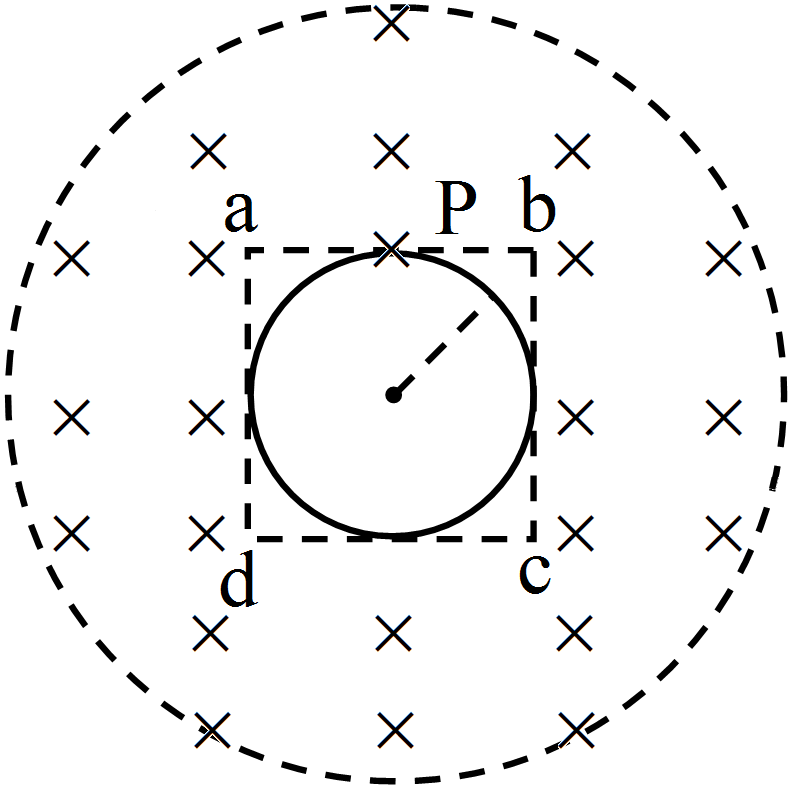
A uniform magnetic field B exists in a cylindrical region, shown dotted in figure. The magnetic field increases at a constant rate $\frac{\text{dB}}{\text{dt}}.$ Consider a circle of radius r coaxial with the cylindrical region.
  1. Find the magnitude of the electric field E at a point on the circumference of the circle.
  2. Consider a point P on the side of the square circumscribing the circle. Show that the component of the induced electric field at P along ba is the same as the magnitude found in part (a).