MCQ
A point traversed $3 / 4$ th of the circle of radius $R$ in time $t$. The magnitude of the average velocity of the particle in this time interval is
  • A
    $\frac{\pi R}{t}$
  • B
    $\frac{3 \pi R}{2 t}$
  • $\frac{R \sqrt{2}}{t}$
  • D
    $\frac{R}{\sqrt{2} t}$

Answer

Correct option: C.
$\frac{R \sqrt{2}}{t}$
c
(c)

$v_{ av }=\frac{\text { Displacement }}{\text { Time }}=\frac{\sqrt{2} R}{t}$

Need a full question paper?

Generate a complete, print-ready paper with questions like this in minutes — across 16+ boards, with answer keys.
Start Generating Free

Similar questions

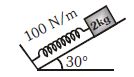
A block of mass $2\,\,kg$ is placed on a rough inclined plane as shown in the figure $(\mu  = 0.2)$ so that it just touches the spring. The block is allowed to move downwards. The spring will be compressed to a maximum of
In the previous question, the smallest kinetic energy at the bottom of the incline will be achieved by:
The extension in a string obeying Hooke's law is $x.$ The speed of sound in the stretched string is $v.$ If the extension in the string is increased to $1.5x$, the speed of sound will be
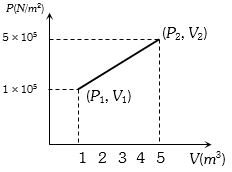
A system changes from the state $({P_1},\;{V_1})$ to $({P_2},{V_2})$ as shown in the figure. What is the work done by the system
Which of the following is a dimension of volt 
Position $x$ of a particle at any instant is related with velocity as $v = \sqrt {2x + 9}$ . The particle starts from origin. Then initial acceleration and velocity are
The mean radius of the earth's orbit round the sun is $1.5 \times 10^{11}.$ The mean radius of the orbit of mercury round the sun is $6 \times10^{10}\,m.$ The mercury will rotate around the sun in
A mixture of two moles of hydrogen and one mole of argon gas is taken in a closed container at room temperature. Consider the following two statements

$(i)$  The average kinetic energy of each molecule of $H_2$ and $Ar$ are the same.

$(ii)$  The partial pressure due to argon gas is more than that due to hydrogen gas

The variation of density of a cylindrical thick and long rod, is $\rho  = {\rho _0}\frac{{{x^2}}}{{{L^2}}}$ , then position of its centre of mass from $x = 0$ end is
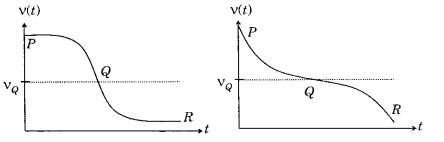
Two loudspeakers $M$ and $N$ are located $20 \mathrm{~m}$ apart and emit sound at frequencies $118 \mathrm{~Hz}$ and $121 \mathrm{~Hz}$, respectively. $A$ car is initially at a point $P, 1800 \mathrm{~m}$ away from the midpoint $Q$ of the line $M N$ and moves towards $Q$ constantly at $60 \mathrm{~km} / \mathrm{hr}$ along the perpendicular bisector of $M N$. It crosses $Q$ and eventually reaches a point $R, 1800(m$ away from $Q$. Let $v(t)$ represent the beat frequency measured by a person sitting in tlie car at time $t$. Let $v_P, v_Q$ and $v_R$ be the beat frequencies measured at locations $P . Q$ and $R$, respectively. The speed of sound in air is $330 \mathrm{~m} \mathrm{~s}^{-1}$. Which of the following statement($s$) is(are) true regarding the sound heard by the person?

($A$) $v_P+v_R=2 v_Q$

($B$) The rate of change in beat frequency is maximum when the car passes through $Q$

($C$) The plot below represents schematically the variation of beat frequency with time

(image)

($D$) The plot below represents schematically the variation of beat frequency with time

(image)