MCQ
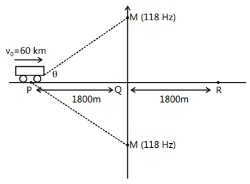
Two loudspeakers $M$ and $N$ are located $20 \mathrm{~m}$ apart and emit sound at frequencies $118 \mathrm{~Hz}$ and $121 \mathrm{~Hz}$, respectively. $A$ car is initially at a point $P, 1800 \mathrm{~m}$ away from the midpoint $Q$ of the line $M N$ and moves towards $Q$ constantly at $60 \mathrm{~km} / \mathrm{hr}$ along the perpendicular bisector of $M N$. It crosses $Q$ and eventually reaches a point $R, 1800(m$ away from $Q$. Let $v(t)$ represent the beat frequency measured by a person sitting in tlie car at time $t$. Let $v_P, v_Q$ and $v_R$ be the beat frequencies measured at locations $P . Q$ and $R$, respectively. The speed of sound in air is $330 \mathrm{~m} \mathrm{~s}^{-1}$. Which of the following statement($s$) is(are) true regarding the sound heard by the person?

($A$) $v_P+v_R=2 v_Q$

($B$) The rate of change in beat frequency is maximum when the car passes through $Q$

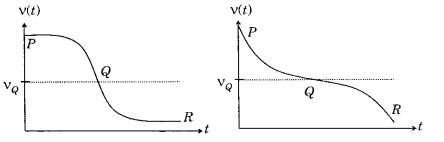
($C$) The plot below represents schematically the variation of beat frequency with time

(image)

($D$) The plot below represents schematically the variation of beat frequency with time

(image)
  • $A,B,C$
  • B
    $A,B,D$
  • C
    $C,B,D$
  • D
    $B,C$

Answer

Correct option: A.
$A,B,C$
a
Frequency of $M$ received by car

$f _1=118\left(\frac{V+V_0 \cos \theta}{V}\right)$

$f _2=121\left(\frac{V+V_0 \cos \theta}{V}\right)$

$Image$

No. of beats $n=\Delta f=f_2-f_1$

$n=3\left(\frac{V+V_0 \cos \theta}{V}\right)$

$n=3\left(1+\frac{V_0}{V} \cos \theta\right)$

As $\theta \uparrow, \cos \theta \downarrow, n \perp$

Rate of change of beat frequency

$\frac{d n}{d \theta}=3\left[\frac{V_0}{V}(-\sin \theta)\right]$

$\frac{d n}{d \theta}$ is maximum when $\sin \theta=1 ; \theta=90^{\circ}$ $i.e.$ car is at point $Q$ .

$v_p=3\left(1+\frac{v_0}{V} \cos \theta\right)$

$v_R=3\left(1-\frac{v_0}{V} \cos \theta\right)$

At $Q$

No. of beats $v_Q=121-118=3$

$v_Q=\frac{v_P+v_R}{2}$

Need a full question paper?

Generate a complete, print-ready paper with questions like this in minutes — across 16+ boards, with answer keys.

Start Generating Free

Similar questions

Two identical coherent sound sources $R$ and $S$ with frequency $f$ are $5 \,m$ apart. An observer standing equidistant from the source and at a perpendicular distance of $12 \,m$ from the line $R S$ hears maximum sound intensity.When he moves parallel to $R S$, the sound intensity varies and is a minimum when he comes directly in front of one of the two sources. Then, a possible value of $f$ is close to ............ $Hz$ (the speed of sound is $330 \,m / s$ )
In a standing wave on a string.
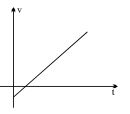
From the velocity time garph of a particle moving in straight line decide which of the following is incorrect statement.
The planet Mars has two moons, if one of them has a period $7\, hours,\, 30\, minutes$ and an orbital radius of $9.0 \times 10^{3}\, {km} .$ Find the mass of Mars.

$\left\{\operatorname{Given} \frac{4 \pi^{2}}{G}=6 \times 10^{11} {N}^{-1} {m}^{-2} {kg}^{2}\right\}$

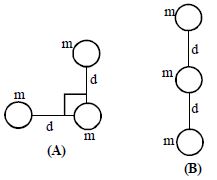
The masses $m$ in fig. $(A)$ and $(B)$ are identical. The gravitational potential energy  in the two cases are $U_A$ and $U_B$. Then
An object suspended by a wire stretches it by $10 \,mm$. When object is immersed in a liquid the elongation in wire reduces by $\frac{10}{3} \,mm$. The ratio of relative densities of the object and liquid is ............
A hollow cone floats with its axis vertical upto one-third of its height in a liquid of relative density $0.8$ and with its vertex submerged. When another liquid of relative density $\rho$ is filled in it upto one-third of its height, the cone floats upto half its vertical height. The height of the cone is $0.10$ $m$ and the radius of the circular base is $0.05$ $m$. The specific gravity $\rho$ is given by
The first law of thermodynamics is a statement of:
The potential energy of a particle varies with distance $x$ from a fixed origin as $V = \frac{{A\sqrt x }}{{x + B}}$,where
$A$ and $B$ are constants. The dimensions of $AB$ are
A stone projected with a velocity u at an angle $\theta$ with the horizontal reaches maximum height $H_1$. When it is projected with velocity u at an angle $\left( {\frac{\pi }{2} - \theta } \right)$ with the horizontal, it reaches maximum height $ H_2$. The relation between the horizontal range R of the projectile, $H_1$ and $H_2$ is