A potentiometer wire has length $10\, m$ and resistance $20\,\Omega $. A $2. 5\, V$ battery of negligible internal resistance is connected across the wire with an $80\,\Omega $ series resistance. The potential gradient on the wire will be
Medium
Download our app for free and get started
(a)Potential gradient $x = \frac{e}{{(R + {R_h} + r)}} \cdot \frac{R}{L}$
$ \Rightarrow $ $x = \frac{{2.5}}{{(20 + 80 + 0)}} \times \frac{{20}}{{10}} = 5 \times {10^{ - 5}}\frac{V}{{mm}}$

Download our appand get started for free
Experience the future of education. Simply download our apps or reach out to us for more information. Let's shape the future of learning together!No signup needed.*
Similar Questions
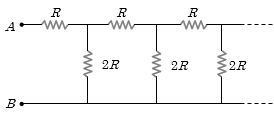
- 1An infinite ladder network is arranged with resistances $R$ and $2 R$ as shown. The effective resistance between terminals $A$ and $B$ isView Solution
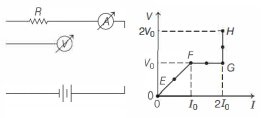
- 2In the circuit shown below (on the left) the resistance and the emf source are both variable. The graph of seven readings of the voltmeter and the ammeter ( $V$ and $I$, respectively) for different settings of resistance and the emf, taken at equal intervals of time $\Delta t$, are shown below (on the right) by the dots connected by the curve $E F G H$. Consider the internal resistance of the battery to be negligible and the voltmeter an ammeter to be ideal devices. (Take, $R_0 \equiv \frac{V_0}{I_0}$ ).View Solution
Then, the plot of the resistance as a function of time corresponding to the curve $E F G H$ is given by
- 3Two wires $A$ and $B$ made of same material and having their lengths in the ratio $6 : 1$ are connected in series. The potential difference across the wires are $3\,V$ and $2\,V$ respectively. If $r_A$ and $r_B$ are the radii of $A$ and $B$ respectively, then $\frac{{{r_B}}}{{{r_A}}}$ isView Solution
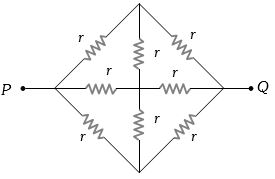
- 4The equivalent resistance between the points $P$ and $Q$ in the network given here is equal to ................ $\Omega$ (given $r = \frac{3}{2}\Omega $)View Solution
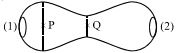
- 5Ametallic conductor of irregular cross-section is as shown in the figure. Aconstant potential difference is applied across the ends $(1)$ and $(2)$. Then :View Solution
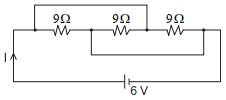
- 6The current $I$ flowing through the given circuit will be $.....A$.View Solution
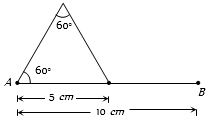
- 7A wire has resistance of $24\,\Omega$ is bent in the following shape. The effective resistance between $A$ and $B$ is .............. $\Omega$View Solution
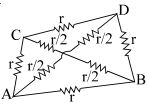
- 8The figure shows a tetrahedron, each side of which has a resistance $r$ If a battery is connected between any two points of the tetrahedron, then identify the correct statement $(s)$.View Solution
- 9A technician has only two resistance coils. By using them singly, in series or in parallel, he is able to obtain the resistance $3,4,12$ and $16 \,ohms$. The resistance of the two coils are ........... $ohms$View Solution
- 10The heat generated through $2 \,ohm$ and $8\, ohm$ resistances separately, when a condenser of $200\,\mu F$ capacity charged to $200\, V$ is discharged one by one, will beView Solution