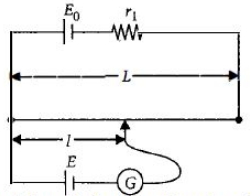
A potentiometer wire of length $L$ and a resistance $r$ are connected in series with a battery of e.m.f. $E_0$ and a resistance $r_1$. An unknown e.m.f. $E$ is balanced at a length $l$ of the potentiometer wire. The e.m.f. $E$ will be given by
AIPMT 2015, Medium


Download our appand get started for free
Experience the future of education. Simply download our apps or reach out to us for more information. Let's shape the future of learning together!No signup needed.*
Similar Questions
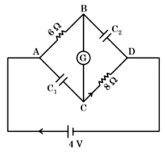
- 1In this figure the resistance of the coil of galvanometer $G$ is $2\,\Omega$. The emf of the cell is $4\,V$. The ratio of potential difference across $C_1$ and $C_2$ is:View Solution
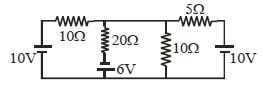
- 2The value of current through $20\,\Omega $ resistor is .................. $A$View Solution
- 3A new flashlight cell of $e.m.f.$ $1.5\, volts$ gives a current of $15\, amps$, when connected directly to an ammeter of resistance $0.04\,\Omega $. The internal resistance of cell is ........... $\Omega$View Solution
- 4The potential difference between $A$ and $B$ in the Figure is ................... $\mathrm{V}$View Solution

- 5A uniform metallic wire has a resistance of $18\,\Omega $ and is bent into an equilateral triangle. Then, the resistance between any two vertices of the triangle is .................. $\Omega$View Solution
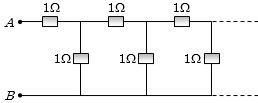
- 6The specific resistance of manganin is $50 \times {10^{ - 8}}\,ohm \times m$. The resistance of a cube of length $50\,cm$ will beView Solution
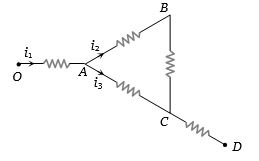
- 7The current in the arm $CD$ of the circuit will beView Solution
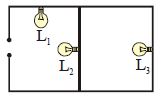
- 8Figure shows three similar lamp. $L_1,L_2$ and $L_3$ connected across a power supply. If the lamp $L_3$ fuses, how will the light emitted by $L_1$ and $L_2$ change ?View Solution
- 9There are two wires of the same length and of the same material and radii $r$ and $2r$ . The ratio of their specific resistance isView Solution
- 10The equivalent resistance between points $A$ and $B$ of an infinite network of resistances each of $1\,\Omega $ connected as shown, isView Solution