MCQ
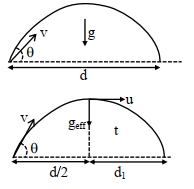
A projectile is fired from horizontal ground with speed $v$ and projection angle $\theta$. When the acceleration due to gravity is $g$, the range of the projectile is $d$. If at the highest point in its trajectory, the projectile enters a different region where the effective acceleration due to gravity is $g^{\prime}=\frac{g}{0.81}$, then the new range is $d^{\prime}=n d$. The value of $n$ is. . . . .
  • A
    $0.40$
  • $0.95$
  • C
    $0.70$
  • D
    $0.80$

Answer

Correct option: B.
$0.95$
b
(image)

$d=\frac{v^2 \sin 2 \theta}{g}$

(image)

$H _{\operatorname{mex}}=\frac{ v ^2 \sin ^2 \theta}{2 g } ; \frac{1}{2} g _{ aff } t ^2= H _{\max } \Rightarrow t ^2=\frac{2 H _{\max }}{ g _{ af }} ; t =\sqrt{\frac{ v ^2 \sin ^2 \theta \times 0.81}{g^2}} ; t =\frac{0.9 v \sin \theta}{ g }$

$t ^2=\frac{2 \times v ^2 \sin ^2 \theta}{2 g \left(\frac{ g }{0.81}\right)}$

$d ^{\prime}=\text { New range }=\frac{d}{2}+ d _1$

$d _1= v \cos \theta^{\circ} t$

$=\frac{ v ^2 \sin ^2 \theta \cos \theta \times 0.9}{ g } ; d ^{\prime}=\frac{ v ^2 \sin 2 \theta}{2 g }+\frac{ v ^2 \sin 2 \theta \times 0.9}{2 g }$

$=\frac{ v ^2 \sin 2 \theta}{ g }\left(\frac{1.0}{2}\right)=0.95 d$

$n =0.95$

Need a full question paper?

Generate a complete, print-ready paper with questions like this in minutes — across 16+ boards, with answer keys.

Start Generating Free

Similar questions

One end of a long metallic wire of length $L$ is tied to the ceiling. The other end is tied to massless spring of spring constant $K$. A mass $ m$ hangs freely from the free end of the spring. The area of cross-section and Young's modulus of the wire are $A$ and $Y$ respectively. If the mass is slightly pulled down and released, it will oscillate with a time period $T$ equal to
The intensity level due to two waves of the same frequency in a given medium are $1\, bel$ and $5\, bel$. Then the ratio of amplitudes is
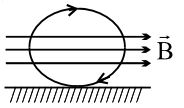
A conducting ring of mass $2\,\, kg$ and radius $0.5\,\ m$ is placed on a smooth horizontal plane. The ring carries a current $i = 4A. A$ horizontal magnetic field $B = 10T$ is switched on at time $t = 0$ as shown in figure. The initial angular acceleration of the ring will be
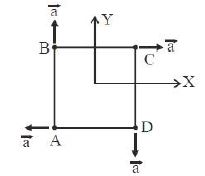
Four particles $A, B, C$ and $D$ with masses $m_A=m, m_B=2m, m_C=3m$ and $m_D=4m$ are at the corners of a square. They have accelerations of equal magnitude with directions as shown. The acceleration of the centre of mass of the particles is
A particle $P$ is moving in a circle of radius $'a'$ with a uniform speed $v$. $C$ is the centre of the circle and $AB$ is a diameter. When passing through $B$ the angular velocity of $P$ about $A$ and $C$ are in the ratio
At a certain instant a stationary transverse wave is found to have maximum kinetic energy. The appearance of string at that instant is
An isosceles glass prism with base angles $40^{\circ}$ is clamped over a tray of water in a position such that the base is just dipped in water. A ray of light incident normally on the inclined face suffers total internal reflection at the base. If the refractive index of water is $1.33$, then the condition imposed on the refractive index $\mu$ of the glass is
A copper wire of length $1.0\, m$ and a steel wire of length $0.5\, m$ having equal cross-sectional areas are joined end to end. The composite wire is stretched by a certain load which stretches the copper wire by $1\, mm$. If the Young's modulii of copper and steel are respectively $1.0\times10^{11}\, Nm^{-2}$ and $2.0\times10^{11}\, Nm^{- 2}$, the total extension of the composite wire is ........ $mm$
Light from a point source falls on a small area placed perpendicular to the incident light. If the area is rotated about the incident light by an angle of $60^o$, by what fraction will the illuminance change
A ball of mass $0.5 \ kg$ is attached to a string of length $50 \ cm$ . The ball is rotated on a horizontal circular path about its vertical axis. The maximum tension that the string can bear is $400 N$ . The maximum possible value of angular velocity of the ball in $\text{rad/s}$ is,: