A copper wire of length $1.0\, m$ and a steel wire of length $0.5\, m$ having equal cross-sectional areas are joined end to end. The composite wire is stretched by a certain load which stretches the copper wire by $1\, mm$. If the Young's modulii of copper and steel are respectively $1.0\times10^{11}\, Nm^{-2}$ and $2.0\times10^{11}\, Nm^{- 2}$, the total extension of the composite wire is ........ $mm$
JEE MAIN 2013, Medium


Download our appand get started for free
Experience the future of education. Simply download our apps or reach out to us for more information. Let's shape the future of learning together!No signup needed.*
Similar Questions
- 1If a spring extends by $x$ on loading, then the energy stored by the spring is (if $T$ is tension in the spring and $k$ is spring constant)View Solution
- 2View SolutionIn the three states of matter, the elastic coefficient can be
- 3A cubical solid aluminium (bulk modulus $=-V \frac{ dP }{ dV }=70 GPa$ ) block has an edge length of $1 m$ on the surface of the earth. It is kept on the floor of a $5 km$ deep ocean. Taking the average density of water and the acceleration due to gravity to be $10^3 kg m ^{-3}$ and $10 ms ^{-2}$, respectively, the change in the edge length of the block in $mm$ is . . . . .View Solution
- 4Two wires $‘A’$ and $‘B’$ of the same material have radii in the ratio $2 : 1$ and lengths in the ratio $4 : 1$. The ratio of the normal forces required to produce the same change in the lengths of these two wires isView Solution
- 5Two steel wires having same length are suspended from a ceiling under the same load. If the ratio of their energy stored per unit volume is $1: 4,$ the ratio of their diameters isView Solution
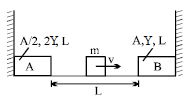
- 6In the given figure, two elastic rods $A$ & $B$ are rigidly joined to end supports. $A$ small mass $‘m’$ is moving with velocity $v$ between the rods. All collisions are assumed to be elastic & the surface is given to be frictionless. The time period of small mass $‘m’$ will be : [$A=$ area of cross section, $Y =$ Young’s modulus, $L=$ length of each rod ; here, an elastic rod may be treated as a spring of spring constant $\frac{{YA}}{L}$ ]View Solution
- 7The elastic limit of brass is $3.5 \times 10^{10}\,N / m ^2$. Find the maximum load that can be applied to a brass wire of $0.75\,mm$ diameter without exceeding the elastic limit$.......\times 10^4\,N$View Solution
- 8The mass and length of a wire are $M$ and $L$ respectively. The density of the material of the wire is $d$. On applying the force $F$ on the wire, the increase in length is $l$, then the Young's modulus of the material of the wire will beView Solution
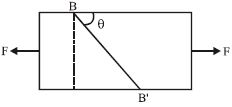
- 9A bar of cross-sectional area $A$ is subjected two equal and opposite tensile forces at its ends as shown in figure. Consider a plane $BB'$ making an angle $\theta $ with the length The ratio of tensile stress to the shearing stress on the plane $BB'$ isView Solution
- 10View SolutionThe adiabatic elasticity of a gas is equal to