MCQ
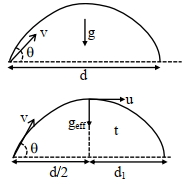
A projectile is fired from horizontal ground with speed $v$ and projection angle $\theta$. When the acceleration due to gravity is $g$, the range of the projectile is $d$. If at the highest point in its trajectory, the projectile enters a different region where the effective acceleration due to gravity is $g^{\prime}=\frac{g}{0.81}$, then the new range is $d^{\prime}=n d$. The value of $n$ is. . . . .
  • A
    $0.40$
  • $0.95$
  • C
    $0.70$
  • D
    $0.80$

Answer

Correct option: B.
$0.95$
b
(image)

$d=\frac{v^2 \sin 2 \theta}{g}$

(image)

$H _{\operatorname{mex}}=\frac{ v ^2 \sin ^2 \theta}{2 g } ; \frac{1}{2} g _{ aff } t ^2= H _{\max } \Rightarrow t ^2=\frac{2 H _{\max }}{ g _{ af }} ; t =\sqrt{\frac{ v ^2 \sin ^2 \theta \times 0.81}{g^2}} ; t =\frac{0.9 v \sin \theta}{ g }$

$t ^2=\frac{2 \times v ^2 \sin ^2 \theta}{2 g \left(\frac{ g }{0.81}\right)}$

$d ^{\prime}=\text { New range }=\frac{d}{2}+ d _1$

$d _1= v \cos \theta^{\circ} t$

$=\frac{ v ^2 \sin ^2 \theta \cos \theta \times 0.9}{ g } ; d ^{\prime}=\frac{ v ^2 \sin 2 \theta}{2 g }+\frac{ v ^2 \sin 2 \theta \times 0.9}{2 g }$

$=\frac{ v ^2 \sin 2 \theta}{ g }\left(\frac{1.0}{2}\right)=0.95 d$

$n =0.95$

Need a full question paper?

Generate a complete, print-ready paper with questions like this in minutes — across 16+ boards, with answer keys.

Start Generating Free

Similar questions

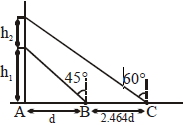
A balloon is moving up in air vertically above a point $A$ on the ground. When it is at a height $h _{1},$ a girl standing at a distance $d$ (point $B$ ) from $A$ (see figure) sees it at an angle $45^{\circ}$ with respect to the vertical. When the balloon climbs up a further height $h _{2},$ it is seen at an angle $60^{\circ}$ with respect to the vertical if the girl moves further by a distance $2.464\, d$ (point $C$ ). Then the height $h _{2}$ is (given tan $\left.30^{\circ}=0.5774\right)$$.......$
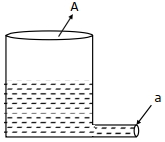
A light cylindrical vessel is kept on a horizontal surface. Area of base is A. A hole of crosssectional area $'a'$ is made just at its bottom side. The minimum coefficient of friction necessary to prevent sliding the vessel due to the impact force of the emerging liquid is $(a\,<\,<\,A)$
Energy of all molecules of a monoatomic gas having a volume $V$ and pressure $P$ is $\frac{3}{2}PV$. The total translational kinetic energy of all molecules of a diatomic gas as the same volume and pressure is
A spring executes $SHM$ with mass of $10\,kg$ attached to it. The force constant of spring is $10\,N/m$.If at any instant its velocity is $40\,cm/sec$, the displacement will be .... $m$ (where amplitude is $0.5\,m$)
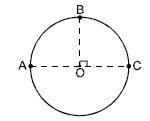
Three particle $A, B$ and $C$ move in a circle of radius $r = \frac{1}{\pi }\,m$, in anticlockwise direction with speeds $1\, m/s$, $2. 5\, m/s$ and $2\, m/s$ respectively. The initial positions of $A, B$ and $C$ are as shown in figure. The ratio of distance travelled by $B$ and $C$ by the instant $A, B$ and $C$ meet for the first time is
A particle of mass $M,$ starting from rest , undergoes uniform acceleration. If the speed acquired in time $T$ is $V,$ the power delivered to the particle is
$N$ divisions on the main scale of a vernier calliper coincide with $(N + 1 )$ divisions of the vernier scale. If each division of main scale is $a$ units , then the least count of the instrument is
As the temperature of a metallic resistor is increased, the product of its resistivity and conductivity:
  1. Increases.
  2. Decreases.
  3. Remains constant.
  4. May increase or decrease.
A flywheel has moment of inertia $4\ kg - {m^2}$ and has kinetic energy of $200\ J$. Calculate the number of revolutions it makes before coming to rest if a constant opposing couple of $5\ N - m$ is applied to the flywheel .......... $rev$
Two, spring $P$ and $Q$ of force constants $k_p$ and ${k_Q}\left( {{k_Q} = \frac{{{k_p}}}{2}} \right)$ are stretched by applying forces of equal magnitude. If the energy stored in $Q$ is $E$, then the energy stored in $P$ is