MCQ
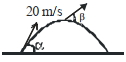
A projectile is launched at an angle ' $\alpha$ ' with the horizontal with a velocity $20 \; ms ^{-1}$. After $10 s$, its inclination with horizontal is ' $\beta$ '. The value of $\tan \beta$ will be : $\left( g =10 \; ms ^{-2}\right)$
  • A
    $\tan \alpha+5 \sec \alpha$
  • $\tan \alpha-5 \sec \alpha$
  • C
    $2 \tan \alpha-5 \sec \alpha$
  • D
    $2 \tan \alpha+5 \sec \alpha$

Answer

Correct option: B.
$\tan \alpha-5 \sec \alpha$
b
$v_{x}=u_{x}=20 \cos \alpha$

$v_{y}=20 \sin \alpha-10 \times 10$

$\tan \beta=\frac{v_{y}}{v_{x}}=\frac{20 \sin \alpha-100}{20 \cos \alpha}$

$=\tan \alpha-5 \sec \alpha$

Need a full question paper?

Generate a complete, print-ready paper with questions like this in minutes — across 16+ boards, with answer keys.

Start Generating Free

Similar questions

$\overrightarrow A = 2\hat i + \hat j,\,B = 3\hat j - \hat k$ and $\overrightarrow C = 6\hat i - 2\hat k$.Value of $\overrightarrow A - 2\overrightarrow B + 3\overrightarrow C $ would be
The moment of inertia of semicircular plate of radius $R$ and mass $M$ about axis $AA’$ in its plane passing through its centre is
A particle has initial velocity $10\,\, m/s$. It moves due to constant retarding force along the line of velocity which produces a retardation of $5\,\, m/s^2$. Then
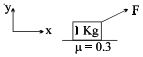
A $\vec F\,\, = \,\,\hat i\, + \,4\hat j\,$ acts on block shown. The force of friction acting on the block is :
A particle executes $SHM $ in a line $4\, cm $ long. Its velocity when passing through the centre of line is $12\, cm/s$. The period will be ..... $s$
The ends of two rods of different materials with their thermal conductivities, radii of cross-sections and lengths all are in the ratio $1:2$ are maintained at the same temperature difference. If the rate of flow of heat in the larger rod is $4\;cal/\sec $, that in the shorter rod in $cal/\sec $ will be
Radius of gyration of a body depends on
A spring whose unstretched length is $\ell $ has a force constant $k$. The spring is cut into two pieces of unstretched lengths $\ell_1$ and $\ell_2$ where, $\ell_1 = n\ell_2$ and $n$ is an integer. The ratio $k_1/k_2$ of the corresponding force constants, $k_1$ and $k_2$ will be
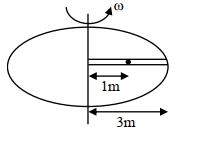
A circular table is rotating with an angular velocity of $\omega \mathrm{rad} / \mathrm{s}$ about its axis (see figure). There is a smooth groove along a radial direction on the table. A steel ball is gently placed at a distance of $1 \mathrm{~m}$ on the groove. All the surface are smooth. If the radius of the table is $3 \mathrm{~m}$, the radial velocity of the ball w.r.t. the table at the time ball leaves the table is $x \sqrt{2} \omega \mathrm{m} / \mathrm{s}$, where the value of $x$ is............
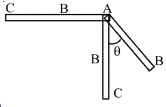
$A$ rod hinged at one end is released from the horizontal position as shown in the figure. When it becomes vertical its lower half separates without exerting any reaction at the breaking point. Then the maximum angle $‘\theta ’$ made by the hinged upper half with the vertical is ......... $^o$.