MCQ
A projectile is projected from ground with initial velocity $\vec u\, = \,{u_0}\hat i\, + \,{v_0}\hat j\,$. If acceleration due to gravity $(g)$  is along the negative $y-$ direction then find maximum displacement in $x-$ direction
  • A
    $\frac {u_0^2}{2g}$
  • $\frac {2u_0v_0}{g}$
  • C
    $\frac {v_0^2}{2g}$
  • D
    $\frac {4u_0v_0}{g}$

Answer

Correct option: B.
$\frac {2u_0v_0}{g}$
b
Given,

$\overrightarrow{ U }=u_0 \hat{1}+v_0 \hat{j}$

$u_0=u \cos \theta \ldots \ldots .1$

$v_0=v \sin \theta \ldots \ldots . .2$

Since,

$R =\frac{ u ^2 2 \sin 2 \theta}{ g }$

$R =\frac{ u ^2 2(\sin \theta \cdot \cos \theta)}{ g } \ldots \ldots$

Substituting the value of equation 1,2 in eqyuation 3 then we get,

$R =\frac{2 u _0 v _0}{ g }$

Need a full question paper?

Generate a complete, print-ready paper with questions like this in minutes — across 16+ boards, with answer keys.

Start Generating Free

Similar questions

The electric field $E$ is measured at a point $P (0,0, d )$ generated due to various charge distributions and the dependence of $E$ on $d$ is found to be different for different charge distributions. List-$I$ contains different relations between $E$ and $d$. List-$II$ describes different electric charge distributions, along with their locations. Match the functions in List-$I$ with the related charge distributions in List-$II$.

 List-$I$  List-$II$
$E$ is independent of $d$ A point charge $Q$ at the origin
$E \propto \frac{1}{d}$ A small dipole with point charges $Q$ at $(0,0, l)$ and $- Q$ at $(0,0,-l)$. Take $2 l \ll d$.
$E \propto \frac{1}{d^2}$ An infinite line charge coincident with the x-axis, with uniform linear charge density $\lambda$
$E \propto \frac{1}{d^3}$ Two infinite wires carrying uniform linear charge density parallel to the $x$-axis. The one along ( $y=0$, $z =l$ ) has a charge density $+\lambda$ and the one along $( y =0, z =-l)$ has a charge density $-\lambda$. Take $2 l \ll d$
  plane with uniform surface charge density


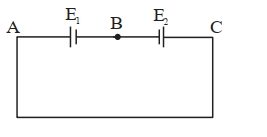
Two cells are connected in opposition as shown. Cell $\mathrm{E}_1$ is of $8 \mathrm{~V}$ emf and $2 \ \Omega$ internal resistance; the cell $E_2$ is of $2 \mathrm{~V}$ emf and $4\  \Omega$ internal resistance. The terminal potential difference of cell $\mathrm{E}_2$ is:
The position of a particle is given by $\overrightarrow r = (\overrightarrow i + 2\overrightarrow j - \overrightarrow k )$ momentum $\overrightarrow P = (3\overrightarrow i + 4\overrightarrow j - 2\overrightarrow k ).$ The angular momentum is perpendicular to
Two bulbs are in parallel and they together consume $48\, W$ from a battery of $6\, V$. The resistance of each bulb is ............ $\Omega$
A satellite of mass $200 \,kg$ revolves around a planet of mass $5 \times 10^{30} \,kg$ in a circular orbit of radius $6.6 \times 10^6 \,m$. Binding energy of the satellite is .............. $J$
In a surface tension experiment with a capillary tube water rises upto $0.1\, m$. If the same experiment is repeated on an artificial satellite, which is revolving around the earth, water will rise in the capillary tube upto a height of
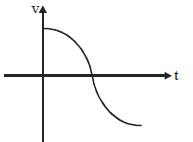
The graph shows the variation with time $t$ of velocity $v$ of an object moving along a straight line. $a-t$ graph will be
In a $RA$ element the fraction of initiated amount remaining after its mean life time is 
Which of the following is dimensionally correct
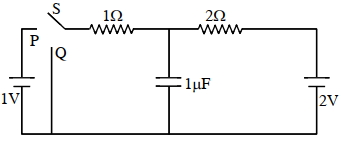
In the circuit shown below, the switch $S$ is connected to position $P$ for a long time so that the charge on the capacitor becomes $q _1 \mu C$. Then $S$ is switched to position $Q$. After a long time, the charge on the capacitor is $q _2 \mu C$.

($1$) The magnitude of $q_1$ is

($2$) The magnitude of $q _2$ is

Give the answer of question ($1$) and ($2$)