Question
A projectile is projected horizontally with a velocity u. Show that its trajectory is parabolic. And obtain expressions for:
i. Time of flight
ii. Horizontal range
iii. Velocity at any instant $t$.
Answer

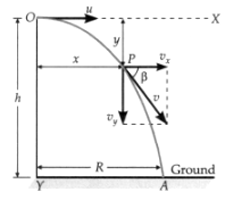
Projectile fired parallel to horizontal. As shown in figure, suppose a body is projected horizontally with velocity u from a point O at a certain height h above the ground level. The body is under the influence of two simultaneous independent motions:
i. Uniform horizontal velocity u.
ii. Vertically downward accelerated motion with constant acceleration g.
Under the combined effect of the above two motions, the body moves along the path OPA.
Image
Horizontal projection of a projectile.
Trajectory of the projectile. After the time $t$, suppose the body reaches the point P (x, y).
The horizontal distance covered by the body in time $t$ is
$
x=\text { ut } \therefore t=\frac{x}{u}
$
The vertical distance travelled by the body in time $t$ is given by
$
s=u t+\frac{1}{2} a t^2
$
or $y =0 \times t+\frac{1}{2} g t^2=\frac{1}{2} g t^2$ [For vertical motion, $u =0$ ]
or $y=\frac{1}{2} g\left(\frac{x}{u}\right)^2=\left(\frac{g}{2 u^2}\right) x^2\left[\because t=\frac{x}{u}\right]$
or $y = kx ^2$ [Here $k =\frac{g}{2 u^2}=$ a constant $]$
As $y$ is a quadratic function of $x$, so the trajectory of the projectile is a parabola.
Time of flight. It is the total time for which the projectile remains in its flight (from O to A ). Let T be its time of flight.
For the vertical downward motion of the body, we use
$s=u t+\frac{1}{2} a t^2$ or $h =0 \times T+\frac{1}{2} g T^2$
or $T-\sqrt{\frac{2 h}{g}}$
Horizontal range. It is the horizontal distance covered by the projectile during its time of flight. It is equal to $O A=R$. Thus $R =$ Horizontal velocity $\times$ time of flight $= u \times T$
or $R =u \sqrt{\frac{2 h}{g}}$
Velocity of the projectile at any instant. At the instant $t$ (when the body is at point P ), let the velocity of the projectile be v . The velocity v has two rectangular components:
Horizontal component of velocity, $v _{ x }= u$
Vertical component of velocity, $v _{ y }=0+ gt = gt$
$\therefore$ The resultant velocity at point $P$ is
$
v=\sqrt{v_x^2+v_y^2}=\sqrt{u^2+g^2 t^2}
$
If the velocity v makes an angle p with the horizontal, then $\tan \beta=\frac{v_y}{v_x}=\frac{g t}{u}$
or $\beta=\tan ^{-1}\left(\frac{g t}{u}\right)$

Need a full question paper?

Generate a complete, print-ready paper with questions like this in minutes — across 16+ boards, with answer keys.

Start Generating Free

Similar questions

A particle is fired vertically upward with a speed of 15km/s. With what speed will it move in intersteller space. Assume only earth's gravitational field.
A body of mass m makes an elastic collision with another identical body at rest. Show that if the collision is not head-on, the bodies go at right angle to each other after the collision.
Can the bulb of a thermometer be made of an adiabatic wall?
A car accelerates from rest at a constant rate α for some time, after which it decelerates at a constant rate $\beta$ to come to rest. If t is the total time elapsed, then calculate.
  1. The maximum velocity attained by the car.
  2. The total distance travelled by the car.
Two coils A and B have inductances 1.0H and 2.0H respectively. The resistance of each coil is $10\Omega.$ Each coil is connected to an ideal battery of emf $2.0V$ at $t = 0$ Let $i_A$ and $i_B$ be the currents in the two circuit at time t. Find the ratio $\frac{\text{i}_\text{A}}{\text{i}_\text{B}}$
  1. t = 100ms
  2. t = 200ms
  3. t = 1s.
The triple points of neon and carbon dioxide are $24.57K$ and $216.55K$ respectively. Express these temperatures on the Celsius and Fahrenheit scales.
Find the acceleration of the block of mass M in the situation of figure. The coefficient of friction between the two blocks is $\mu_1$ and that between the bigger block and the ground is $\mu_2.$
To what height a mass can go, when sent up with a velocity half of the escape velocity?
i. Analytically, find the resultant $\vec{R}$ of two vectors $\vec{A}$ and $\vec{B}$ inclined at an angle $\theta$.
ii. Find the angle between two vectors $\vec{P}$ and $\vec{Q}$ if resultant of the vectors is given by $R ^2= P ^2+ Q ^2$.
A gun kept on a straight horizontal road is used to hit a car travelling along the same road away from the gun with a uniform speed of 72km/ h. The car is at a distance of 500m from the gun when the gun is fired at an angle of 45° to the horizontal. Find,
  1. The distance of the car from the gun when the shell hits it.
  2. The speed of projection of the shell from the gun.