Question
Two coils A and B have inductances 1.0H and 2.0H respectively. The resistance of each coil is $10\Omega.$ Each coil is connected to an ideal battery of emf $2.0V$ at $t = 0$ Let $i_A$ and $i_B$ be the currents in the two circuit at time t. Find the ratio $\frac{\text{i}_\text{A}}{\text{i}_\text{B}}$
  1. t = 100ms
  2. t = 200ms
  3. t = 1s.

Answer

$\text{L}_\text{a}=1.0\text{ H }; \text{ L}_\text{B}=2.0\text{H}; \ \text{R}=10\omega$
  1. $\text{t}=0.1\text{s}, \ \tau_\text{A}=0.1, \ \tau_\text{B}=\frac{\text{L}}{\text{R}}=0.2$
$\text{i}_{\text{A}}=\text{i}_0\Big(1-\text{e}^\frac{-\text{t}}{\tau}\Big)$
$=\frac{2}{10}\Big(1-\text{e}^\frac{-0.1\times10}{1}\Big)=0.2\Big(1-\text{e}^{-1}\Big)=0.126424111$
$\text{i}_\text{B}=\text{i}_0\Big(1-\text{e}\frac{-\text{t}}{\tau}\Big)$
$=\frac{2}{10}\Big(1-\text{e}^\frac{-0.1\times10}{2}\Big)=0.2\Big(1-\text{e}^\frac{-1}{2}\Big)=0.078693$
$\frac{\text{i}_\text{A}}{\text{i}_\text{B}}=\frac{0.12642411}{0.78693}=1.6$
  1. $\text{t}=200\text{ms}=0.2\text{s}$
$\text{i}_\text{A}=\text{i}_0\Big(1-\text{e}^\frac{-\text{t}}{\tau}\Big)$
$=0.2\Big(1-\text{e}^\frac{-0.2\times10}{1}\Big)=0.2\times0.864664716=0.172932943$
$\text{i}_\text{B}=0.2\Big(1-\text{e}^\frac{-0.2\times10}{2}\Big)=0.2\times0.632120=0.126424111$
$\frac{\text{i}_\text{a}}{\text{i}_\text{B}}=\frac{0.172932943}{0.126424111}=1.36=1.4$
  1. $\text{t}=1\text{s}$
$\text{i}_\text{A}=0.2\Big(1-\text{e}^\frac{-1\times10}{1}\Big)=0.2\times0.9999546=0.19999092$
$\text{i}_\text{B}=0.2\Big(1-\text{e}^\frac{-1\times10}{2}\Big)=0.2\times0.99326=0.19865241$
$\frac{\text{i}_\text{A}}{\text{i}_\text{B}}=\frac{0.19999092}{19865241}=1.0$

Need a full question paper?

Generate a complete, print-ready paper with questions like this in minutes — across 16+ boards, with answer keys.

Start Generating Free

Similar questions

One end of a long string of linear mass density $8.0 \times 10^{–3}kg m^{–1}$ is connected to an electrically driven tuning fork of frequency $256Hz$. The other end passes over a pulley and is tied to a pan containing a mass of $90kg$. The pulley end absorbs all the incoming energy so that reflected waves at this end have negligible amplitude. At $t = 0$, the left end (fork end) of the string $x = 0$ has zero transverse displacement $(y = 0)$ and is moving along positive y-direction. The amplitude of the wave is $5.0cm$. Write down the transverse displacement y as function of x and t that describes the wave on the string.
A marble rolls along a table at a constant speed of $1.00m/ s$ and then falls off the edge of the table to the floor $1.00m$ below.
  1. How long does the marble take to reach the floor?
  2. At what horizontal distance from the edge of the table does the marble land?
  3. What is its velocity as it strikes the floor?
The equation of motion of a particle started at t = 0 is given by $\text{x}=5\sin\big(20\text{t}+\frac{\pi}{3}\big)$ where x is in centimetre and t in second. When does the particle.
  1. First come to rest.
  2. First have zero acceleration.
  3. First have maximum speed?
A block of mass 2.0kg kept at rest on an inclined plane of inclination $37^\circ $ is pulled up the plane by applying a constant force of 20N parallel to the incline. The force acts for one second.
  1. Show that the work done by the applied force does not exceed 40J.
  2. Find the work done by the force of gravity in that one second if the work done by the applied force is 40J.
  3. Find the kinetic energy of the block at the instant the force ceases to act. Take $g = 10m/s^2.$
A horizontal cesium plate ($\phi$ = 1.9eV) is moved vertically downward at a constant speed u in a room full of radiation of wavelength 250 run and above. What should be the minimum value of u so that the vertically upward component of velocity is nonpositive for each photoelectron?
Explain Aristotle's Fallacy and Galileo's refutation.
Two identical steel cubes (masses $50g$, side $1cm$) collide head-on face to face with a speed of $10cm/ s$ each. Find the maximum compression of each. Young’s modulus for steel = $Y = 2 \times 1011 N/ m^2$.
In an experiment to estimate the size of a molecule of oleic acid $1mL$ of oleic acid is dissolved in $19mL$ of alcohol. Then $1mL$ of this solution is diluted to $20mL$ by adding alcohol. Now $1$ drop of this diluted solution is placed on water in a shallow trough. The solution spreads over the surface of water forming one molecule thick layer. Now, lycopodium powder is sprinkled evenly over the film and its diameter is measured. Knowing the volume of the drop and area of the film we can calculate the thickness of the film which will give us the size of oleic acid molecule. Read the passage carefully and answer the following questions:
  1. Why do we dissolve oleic acid in alcohol?
  2. What is the role of lycopodium powder?
  3. What would be the volume of oleic acid in each $mL$ of solution prepared?
  4. How will you calculate the volume of $n$ drops of this solution of oleic acid?
  5. What will be the volume of oleic acid in one drop of this solution?
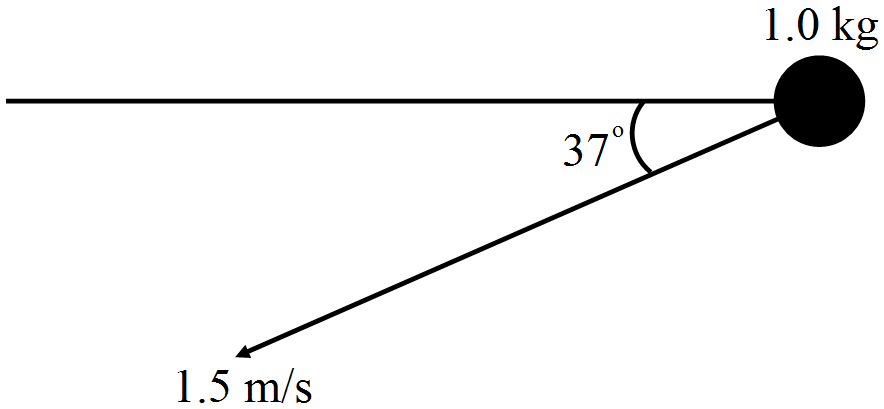
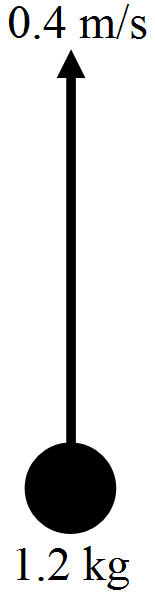
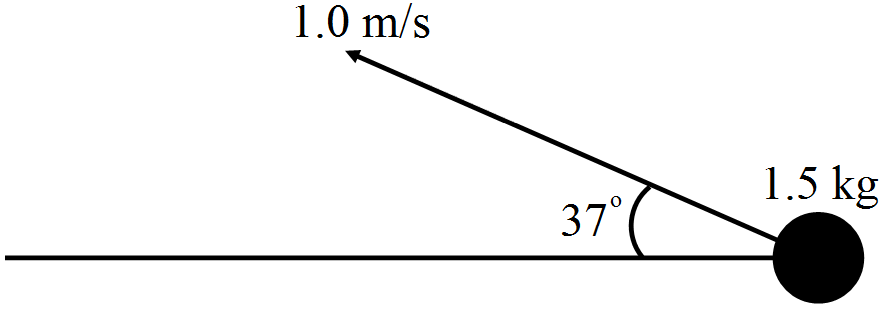
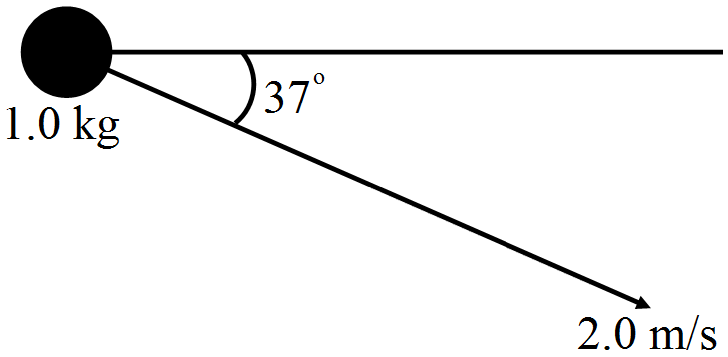
Calculate the velocity of the centre of mass of the system of particles shown in figure.


A boy standing on a stationary lift (open from above) throws a ball upwards with the maximum initial speed he can, equal to $49m s^{–1}$. How much time does the ball take to return to his hands? If the lift starts moving up with a uniform speed of $5m s^{-1}$ and the boy again throws the ball up with the maximum speed he can, how long does the ball take to return to his hands?