MCQ
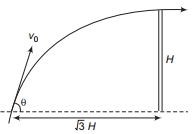
A projectile is thrown at an angle $\theta$ such that it is just able to cross a vertical wall at its highest point as shown in the figure.The angle $\theta$ at which the projectile is thrown is given by
  • A
    $\tan ^{-1}\left(\frac{1}{\sqrt{3}}\right)$
  • B
    $\tan ^{-1}(\sqrt{3})$
  • $\tan ^{-1}\left(\frac{2}{\sqrt{3}}\right)$
  • D
    $\tan ^{-1}\left(\frac{\sqrt{3}}{2}\right)$
Answer

Correct option: C.
$\tan ^{-1}\left(\frac{2}{\sqrt{3}}\right)$
c
(c)

$\frac{R / 2}{H}=\frac{\sqrt{3} H}{H}=\sqrt{3}$

or $\frac{\left(v_0^2 \sin \theta \cos \theta\right) / g}{\left(v_0^2 \sin ^2 \theta\right) / 2 g}=\sqrt{3}$

$2 \cot \theta=\sqrt{3}$

or $\tan \theta=\frac{2}{\sqrt{3}}$

or $\theta=\tan ^{-1}\left(\frac{2}{\sqrt{3}}\right)$

Need a full question paper?

Generate a complete, print-ready paper with questions like this in minutes — across 16+ boards, with answer keys.

Start Generating Free

Similar questions

If the external force acting on a system have zero resultant, the centre of mass:
  1. Must not move.
  2. Must not accelerate.
  3. May move.
  4. May accelerate.
$m x^{2}-b x+k=0$

Find time after which to the energy will become half of initial maximum value in damped force oscillation.

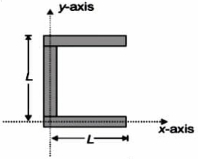
Locate the centre of mass of arrangement shown in figure. The three rods are identical in mass and length
$Assertion$ : Velocity-time graph for an object in uniform motion along a straight path is a straight line parallel to the time axis.

$Reason$ : In uniform motion of an object velocity increases as the square of time elapsed.

If the length of the second's hand in a stop clock is $3 \,cm$ the angular velocity and linear velocity of the tip is
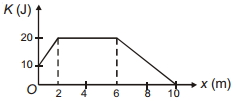
The kinetic energy $K$ of a particle moving along $x$-axis varies with its position $(x)$ as shown in figure The magnitude of force acting on particle at $x=9 \,m$ is ............ $N$
A force of $19.6\, N$ when applied parallel to the surface just moves a body of mass $10 \,kg$ kept on a horizontal surface. If a $5\, kg$ mass is kept on the first mass, the force applied parallel to the surface to just move the combined body is........ $N.$ 
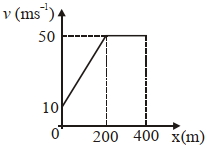
The velocity-displacement graph describing the motion of a bicycle is shown in the figure.

The acceleration-displacement graph of the bicycle's motion is best described by

Two cyllinders of same cross-section and length $L$ but made of two material of densities $d_1$ and $d_2$ are cemented together to form a cylinder of length $2L$. The combination floats in a liquid of density $d$ with $a$ length $L/2$ above the surface of the liquid. If $d_1 > d_2$ then:
A tuning fork gives $5$ beats with another tuning fork of frequency $100\,Hz.$ When the first tuning fork is loaded with wax, then the number of beats remains unchanged, then what will be the frequency of the first tuning fork ..... $Hz$