MCQ
A projectile is thrown with speed $40 \,ms ^{-1}$ at angle $\theta$ from horizontal. It is found that projectile is at same height at $1 \,s$ and $3 \,s$. What is the angle of projection?
  • A
    $\tan ^{-1}\left(\frac{1}{\sqrt{2}}\right)$
  • $\tan ^{-1}\left(\frac{1}{\sqrt{3}}\right)$
  • C
    $\tan ^{-1}(\sqrt{3})$
  • D
    $\tan ^{-1}(\sqrt{2})$

Answer

Correct option: B.
$\tan ^{-1}\left(\frac{1}{\sqrt{3}}\right)$
b
(b)

$\tan \theta=\frac{v_y}{v_x}$

Also, $t_1+t_2=\frac{2 u \sin \theta}{g}$

$4=\frac{2 \times 40 \times \sin \theta}{10}$

$\sin \theta=\frac{1}{2} \Rightarrow \theta=30^{\circ}$

So, $\tan \theta=\tan 30^{\circ} \Rightarrow \frac{1}{\sqrt{3}}$

$\theta=\tan ^{-1}\left(\frac{1}{\sqrt{3}}\right)$

Need a full question paper?

Generate a complete, print-ready paper with questions like this in minutes — across 16+ boards, with answer keys.

Start Generating Free

Similar questions

Moment of inertia of a sphere of mass $M$ and radius $R$ is $I.$ Keeping $M$ constant if a graph is plotted between $I $ and $R,$ then its form would be
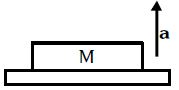
A block of mass $M$ is kept on a platform which starts accelerating upwards from rest with a constant acceleration $a$ . During the time interval $T$ the work done by contact force on mass $M$ is
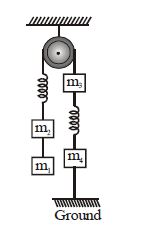
For the system shown in figure, $m_1>m_2>m_3 >m_4$ . Initially, the system is at rest in equilibrium condition. If the string joining $m_4$ and ground is cut, then just after the string is cut :

Statement $I$ $m_1$ ,$m_2$ ,$m_3$ remain stationary.

Statement $II$ The value of acceleration of all the $4$ blocks can be determined.

Statement $III$ Only $m_4$ remains stationary.

Statement $IV$ Only $m_4$ accelerates.

Statement $V$ All the four blocks remain stationary.

Now, choose the correct option.

A cubic metal block of mass $5 \,kg$ and edge length $0.1 \,m$ and at an initial temperature of $100^{\circ} C$ is placed on a thermally insulating flat surface and exposed to air at $0^{\circ} C$. The time in seconds required to cool the block to a temperature of $37^{\circ} C$ is closest to

(Note: Specific heat of the metal $=500 \,J / kg /{ }^{\circ} C$; Heat transfer coefficient from block to air $=50 \,W / m ^2 /{ }^{\circ} C$ )

The distance of the Sun from earth is $1.5 \times 10^{11} \,m$ and its angular diameter is $(2000) \,s$ when observed from the earth. The diameter of the Sun will be ...........
If one wants to remove all the mass of the earth to infinity in order to break it up completely. The amount of energy that needs to be supplied will be $\frac{x}{5}\, \frac{ GM ^{2}}{ R }$ where $x$ is $\quad\,..........$ (Round off to the Nearest Integer)

($M$ is the mass of earth, $R$ is the radius of earth, $G$ is the gravitational constant)

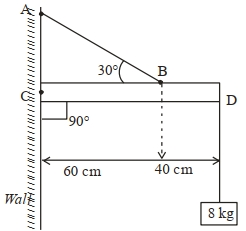
An object of mass $8\,kg$ is hanging from one end of a uniform rod $CD$ of mass $2\,kg$ and length $1\,m$ pivoted at its end $C$ on a vertical wall as shown in figure. It is supported by a cable $A B$ such that the system is in equilibrium. The tension in the cable is $............\,N$ (Take $g=10\,m / s ^2$ )
A razor-blade floats on the surface of water contained in a glass. When the glass is gently shaken, the razor-blade sinks. Mark the incorrect statement
A hollow sphere and a solid sphere having same mass and same radii are rolled down a rough inclined plane:
  1. The hollow sphere reaches the bottom first.
  2. The solid sphere reaches the bottom with greater speed.
  3. The solid sphere reaches the bottom with greater kinetic energy.
  4. The two spheres will reach the bottom with same linear momentum.
A particle of mass m is at the surface of the earth of radius R. It is lifted to a heighth abov the surface of the earth. The gain in gravitational potential energy of the particle is: