MCQ
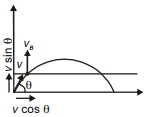
A projectile is thrown with velocity $v$ at an angle $\theta$ with horizontal. When the projectile is at a height equal to half of the maximum height, the vertical component of the velocity of projectile is ...........
  • A
    $v \sin \theta \times 3$
  • B
    $\frac{v \sin \theta}{3}$
  • $\frac{v \sin \theta}{\sqrt{2}}$
  • D
    $\frac{v \sin \theta}{\sqrt{3}}$

Answer

Correct option: C.
$\frac{v \sin \theta}{\sqrt{2}}$
c
(c)

$v_B^2=v^2 \sin ^2 \theta-\frac{2 g}{2}\left(\frac{u^2 \sin ^2 \theta}{2 g}\right)$

$v_B^2=\frac{v^2 \sin ^2 \theta}{2}$

$v_B=\frac{v \sin \theta}{\sqrt{2}}$

Need a full question paper?

Generate a complete, print-ready paper with questions like this in minutes — across 16+ boards, with answer keys.

Start Generating Free

Similar questions

Unit vector parallel to the resultant of vectors $\vec A = 4\hat i - 3\hat j$and $\vec B = 8\hat i + 8\hat j$ will be
A screw gauge has $50$ divisions on its circular scale. The circular scale is $4$ units ahead of the pitch scale marking, prior to use. Upon one complete rotation of the circular scale, a displacement of $0.5\, mm$ is noticed on the pitch scale. The nature of zero error involved, and the least count of the screw gauge, are respectively
Abody is moving uni-directionally under the influence of a source of constant power. Its displacement in time $t$ is proportional to
Starting from the origin at time $t=0,$ with initial velocity $5 \hat{ j }\, ms ^{-1},$ a particle moves in the $x-y$ plane with a constant acceleration of $(10 \hat{ i }+4 \hat{ j })\, ms ^{-2}$. At time $t$, its coordinates are $\left(20\, m , y _{0}\, m \right) .$ The values of $t$ and $y _{0},$ are respectively
The intensity of a progressing plane wave in loss-free medium is
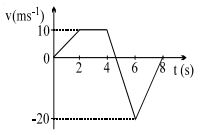
The figure shows a velocity-time graph of a particle moving along a straight line  The correct displacement-time graph of the particle is shown as
The magnitude of vector $\overrightarrow A ,\,\overrightarrow B $ and $\overrightarrow C $ are respectively $12, 5$ and $13$ units and $\overrightarrow A + \overrightarrow B = \overrightarrow C $ then the angle between $\overrightarrow A $ and $\overrightarrow B $ is
Which one of the following molecules does not possess vibrational energy?
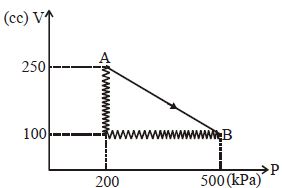
A monoatomic gas is taken along path $AB$ as shown. Calculate change in internal energy of system
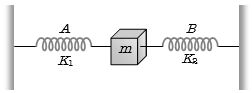
In arrangement given in figure, if the block of mass m is displaced, the frequency is given by