MCQ
A projectile moving vertically upwards with a velocity of $200\, ms^{-1}$ breaks into two equal parts at a height of $490\, m$. One part starts moving vertically upwards with a velocity of $400\, ms^{-1}$. How much time it will take, after the break up with the other part to hit the ground? .............. $\mathrm{s}$
  • A
    $2\sqrt {10}$
  • B
    $5$
  • $10$
  • D
    $\sqrt {10}$

Answer

Correct option: C.
$10$
c
$YX$

$v = 400 m/s$

$Mass \,before\, explosion = m$

$490\, m\, and\, velocity \,v = 200\, m/s\, (vertically)$

Momentum before explosion

 $=$Momentum after explosion

$\begin{array}{l}
m \times 200\hat j\, = \frac{m}{2} \times 400\hat j + \frac{m}{2}\,v\\
\,\,\,\,\,\,\,\,\,\,\,\,\,\,\,\,\,\,\,\, = \frac{m}{2}\left( {400\,\hat j + v} \right)
\end{array}$

$\begin{array}{l}
 \Rightarrow \,400\,\hat j - 400\hat j = v\\
\therefore \,\,v = 0
\end{array}$

i.e., the velocity of the other part of the mass, $v = 0$

Let time taken to reach the earth by this part be $t$

Applying formula, $h = ut +$ $\frac{1}{2}g{t^2}$

$\begin{array}{l}
490 = 0 + \frac{1}{2} \times 9.8 \times {t^2}\\
 \Rightarrow \,{t^2} = \frac{{980}}{{9.8}} = 100\\
\therefore \,\,t = \sqrt {100}  = 10\sec 
\end{array}$

Need a full question paper?

Generate a complete, print-ready paper with questions like this in minutes — across 16+ boards, with answer keys.

Start Generating Free

Similar questions

The mass of the moon is $\frac{1}{{81}}$ of the earth but the gravitational pull is $\frac{1}{6}$ of the earth. It is due to the fact that
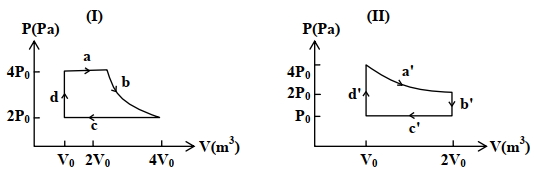
One mole of an ideal gas undergoes two different cyclic processes I and II, as shown in the $P-V$ diagrams below. In cycle I, processes $a, b, c$ and $d$ are isobaric, isothermal, isobaric and isochoric, respectively. In cycle II, processes $a^{\prime}, b^{\prime}, c^{\prime}$ and $d^{\prime}$ are isothermal, isochoric, isobaric and isochoric, respectively. The total work done during cycle I is $W_I$ and that during cycle II is $W_{I I}$. The ratio $W_I / W_{I I}$ is . . . .

(image)

Position of a particle in a rectangular-co-ordinate system is $(3, 2, 5)$. Then its position vector will be
A rod of length $10\ meter$ at $0\,^oC$ having expansion coefficient $\alpha  = (2x^2 + 1) \times  10^{-6}\,C^{-1}$ where $x$ is the distance from one end of rod. The length of rod at $10\,^oC$ is
The ratio of radiant energies radiated per unit surface area by two bodies is $16 : 1$ , the temperature of hotter body is $1000K$ , then the temperature of colder body will be ....... $K$
The position $x$ of a particle varies with time $t$ as $x = a{t^2} - b{t^3}$. The acceleration of the particle will be zero at time $t$ equal to
Two bodies are held separated by $9.8\,m$ vertically one above the other. They are released simultaneously to fall freely under gravity. After $2\,s$, the relative distance between them is $............\,m$
Water rises upto a height $h$ in a capillary on the surface of earth in stationary condition. Value of $h$ increases if this tube is taken
The time period of a seconds pendulum is $2\, sec$. The spherical bob which is empty from inside has a mass $50\; gram$, this now is replaced by another solid of same radius but have different mass of $100\; gram$. The new time period will be ..... $\sec$
Given below are two statements:

Statement $I:$ Area under velocity- time graph gives the distance travelled by the body in a given time.

Statement $II:$ Area under acceleration- time graph is equal to the change in velocity- in the given time.

In the light of given statements, choose the correct answer from the options given below.