MCQ
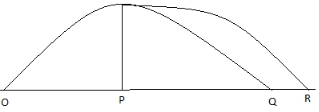
A projectile of mass $M$ is fired so that the horizontal range is $4\, km$. At the highest point the projectile explodes in two parts of masses $M/4$ and $3M/4$ respectively and the heavier part starts falling down vertically with zero initial speed. The horizontal range (distance from point of firing) of the lighter part is .................. $\mathrm{km}$
  • A
    $16$
  • B
    $1$
  • $10$
  • D
    $2$

Answer

Correct option: C.
$10$
c
$OQ=4\;km$

$QR=x\;km$

The centre of mass will hit the ground at point $Q$. As the haviour mass comes to rest after bracking

${x_{cm}} = \frac{{{m_1}{x_1} + {m_2}{x_2}}}{{{m_1} + {m_2}}}$

$\;Here\;{m_{1\;}} = \frac{{3M}}{4},{m_{2\;}} = \frac{M}{4},\;$$\;{x_{1\;}} = OP = 2,\;{x_{2\;}} = OR\; = \;4 + x$

So,

$4 = \frac{{\frac{{3M}}{4} \times 2 + \frac{M}{4} \times \left( {4 + x} \right)}}{M}$

$4M = \frac{{3M}}{2} + M\left( {1 + \frac{x}{4}} \right)1 + \frac{x}{4} $$= \frac{5}{2}\frac{x}{4} = \frac{3}{2}x = 6\;km$

Hence horizontal range of lighter particle is

$OR = OQ + QR = 4+6 = 10\; km$

Need a full question paper?

Generate a complete, print-ready paper with questions like this in minutes — across 16+ boards, with answer keys.

Start Generating Free

Similar questions

A strap is passing over a wheel of radius $30\, cm.$ During the time the wheel moving with initial constant velocity of $2\, rev/sec.$ comes to rest the strap covers a distance of $25\, m.$ The deceleration of the wheel in $rad/s$$^2$ is
A rod has length 3 m and its mass acting per unit length is directly proportional to distance x from one of its end, then its centre of gravity from that end will be at
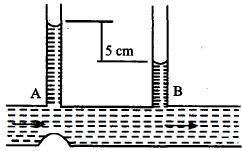
In the diagram shown, the difference in the two tubes of the manometer is $5\, cm$, the cross section of the tube at $A$ and $B$ is $6\, mm^2$ and $10\, mm^2$ respectively. The rate at which water flows through the tube is ........ $ cc/s$ $(g\, = 10\, ms^{-2})$
A system consists of two types of gas molecules $A$ and $B$ having same number density $2 \times$ $10^{25}\, / {m}^{3}$. The diameter of ${A}$ and ${B}$ are $10\, \stackrel{\circ}{{A}}$ and $5\, \stackrel{\circ}{{A}}$ respectively. They suffer collision at room temperature. The ratio of average distance covererd by the molecule $A$ to that of $B$ between two successive collision is $.....\,\times 10^{-2}$
Match List$-I$ With List$-II$

$(a)$ Gravitational constant $(G)$ $(i)$ $\left[ L ^{2} T ^{-2}\right]$
$(b)$ Gravitational potential energy $(ii)$ $\left[ M ^{-1} L ^{3} T ^{-2}\right]$
$(c)$ Gravitational potential $(iii)$ $\left[ LT ^{-2}\right]$
$(d)$ Gravitational intensity $(iv)$ $\left[ ML ^{2} T ^{-2}\right]$

Choose the correct answer from the options given below:

With what velocity should a particle be projected so that its height becomes equal to radius of earth?
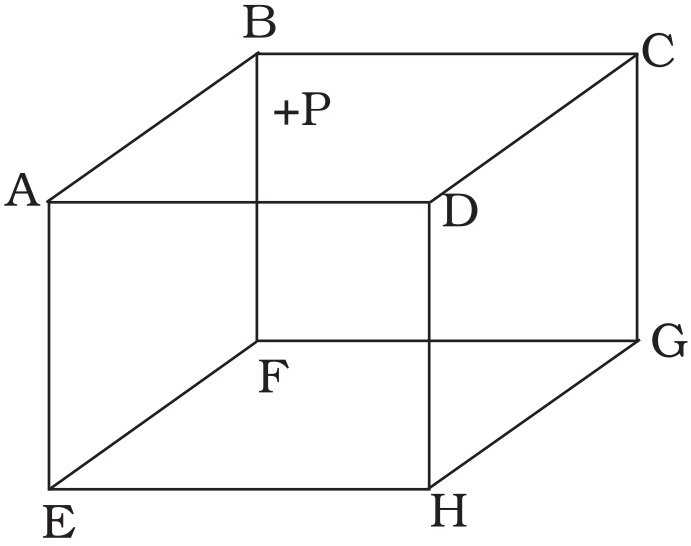
$\text{ABCDEFGH}$ is a hollow cube made of an insulator $($figure$)$ face $\text{ABCD}$ has positive charge on it. Inside the cube, we have ionised hydrogen. The usual kinetic theory expression for pressure.
Maximum and minimum magnitudes of the resultant of two vectors of magnitudes $P$ and $Q$ are in the ratio $3:1.$ Which of the following relations is true
Two satellites revolve around a planet in coplanar circular orbits in anticlockwise direction. Their period of revolutions are $1\, hour$ and $8\, hours$ respectively. The radius of the orbit of nearer satellite is $2 \times 10^{3}\, {km}$. The angular speed of the farther satellite as observed from the nearer satellite at the instant when both the satellites are closest is $\frac{\pi}{{x}}\, {rad} \,{h}^{-1}$ where ${x}$ is ..... .
Boyle' law is applicable for an: