Question

A proton accelerated by a potential difference 500 KV moves though a transverse magnetic field of 0.51T as shown in figure. The angle θ through which the proton deviates from the initial direction of its motion is

(a) 15°

(b) 30°

(c) 45°

(d) 60°

Answer

(b) 30°

Need a full question paper?

Generate a complete, print-ready paper with questions like this in minutes — across 16+ boards, with answer keys.

Start Generating Free

Similar questions

Two streams of protons move parallel to each other in the same direction. They will:
If we increase the driving frequency in a circuit with a purely resistive load, then amplitude VR​.

A parallel plate capacitor is made by stacking n equally spaced plates connected alternately. If the capacitance between any two plates is  C then the resultant capacitance is

(a) C

(b) nC

(c) (n – 1)C

(d) (n + 1)C

The chemical equivalent of silver is 108. If the current in a silver voltameter is 2 Amp., the time required to deposit 27 grams of silver will be

(a) 8.57 hrs

(b) 6.70 hrs

(c) 3.35 hrs

(d) 12.50 hrs

A sonometer wire of length l vibrates in fundamental mode when excited by a tuning fork of frequency 416Hz. If the length is doubled keeping other things same, the string will:
  1. Vibrate with a frequency of 416Hz
  2. Vibrate with a frequency of 208Hz
  3. Vibrate with a frequency of 832Hz
  4. Stop vibrating.
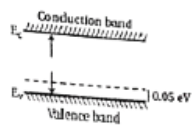
What is the type of the semiconductor, for the energy band diagram shown in the figure?
Image
An inductor, a resistance and a capacitor are joined in series with an AC source. As the frequency of the source is slightly increased from a very low value, the reactance:
A particle having mass $m$ and charge $q$ is at rest. On applying a uniform electric field E on it, it starts moving. What is its kinetic energy when it travels a distant y in the direction of force ?

The lateral displacement depends on ______:

Two infinitely long parallel conducting plates having surface charge densities +σ and -σ respectively, are separated by a small distance. The medium between the plates is vacuum. If  is the dielectric permittivity of vacuum, then the electric field in the region between the plates is

(a) 0 volts/meter

(b)  volts/meter

(c)  volts/meter

(d)  volts/meter