Question

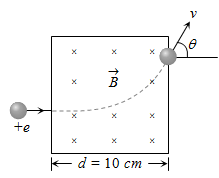
A proton accelerated by a potential difference 500 KV moves though a transverse magnetic field of 0.51T as shown in figure. The angle θ through which the proton deviates from the initial direction of its motion is
(a) 15°

(b) 30°

(c) 45°

(d) 60°

Answer

(b) 30°

Need a full question paper?

Generate a complete, print-ready paper with questions like this in minutes — across 16+ boards, with answer keys.

Start Generating Free

Similar questions

A person's near point is 50 cm and his far point is 3 m. Power of the lenses he requires for

(i)  reading and  (ii) for seeing distant stars are

(a) – 2 D and 0.33 D

(b) 2 D and – 0.33 D

(c) – 2 D and 3 D

(d) 2 D and – 3 D

The earth's magnetic induction at a certain point is 7 × .  This is to be annulled by the magnetic induction at the centre of a circular conducting loop of radius 5 cm. The required current in the loop is

(a) 0.56 A

(b) 5.6 A

(c) 0.28 A  

(d) 2.8 A

The coefficient of mutual inductance between two coils depends on.

In a plano-convex lens the radius of curvature of the convex lens is 10 cm.  If the plane side is polished, then the focal length will be (Refractive index = 1.5)

(a) 10.5 cm

(b) 10 cm

(c) 5.5 cm

(d) 5 cm

Energy of electron in excited hydrogen atom is -3.4 eV . According to Bohr's theory, its angular momentum will be :

The force between two charges 0.06 m apart is 5 N. If each charge is moved towards the other by 0.01 m, then the force between them will become

(a) 7.20 N

(b) 11.25 N

(c) 22.50 N

(d) 45.00 N

Two identical light sources S1 and S2 emit light of same wavelength l. These light rays will exhibit interference if

(a) Their phase differences remain constant

(b) Their phases are distributed randomly

(c) Their light intensities remain constant

(d) Their light intensities change randomly

Albert Einstein got a nobel prize in physics for his work on:

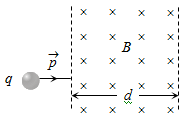
A particle with charge q, moving with a momentum p, enters a uniform magnetic field normally. The magnetic field has magnitude B and is confined to a region of width d, where d <  , The particle is deflected by an angle θ in crossing the field

(a) sinθ =  

(b) sinθ =

(c) sinθ =

(d) sinθ =

A magnetic field can be produced by: