Question
A proton and an α-particle are accelerated, using the same potential difference. How are the de-Broglie wavelengths $\lambda _p$ and $\lambda _a$​​​​​​​ related to each other?

Answer

Key concept: Hence de-Broglie wavelength: $\lambda=\frac{\text{h}}{\text{p}}=\frac{\text{h}}{\sqrt{2\text{mE}}}=\frac{\text{h}}{\sqrt{2\text{mqV}}}$ In this problrm since both proton and $\alpha-\text{particle}$ are accelerated through same potential difference, We know that, $\lambda=\frac{\text{h}}{\sqrt{2\text{mqv}}}$ $\therefore\ \lambda\propto\frac{1}{\sqrt{\text{mq}}}$ $\frac{\lambda_\text{p}}{\lambda_\alpha}=\frac{\sqrt{\text{m}_\alpha\text{q}_\alpha}}{\text{m}_\text{p}\text{q}_\text{p}}=\frac{\sqrt{4\text{m}_\text{p}\times2\text{e}}}{\sqrt{\text{m}_\text{p}\times\text{e}}}=\sqrt{8}$ $\therefore\ \lambda_\text{p}=\sqrt{8}\lambda_\alpha$ i.e., wavelength of proton is times wavelength of $\alpha-\text{particle}$.
Important point:
De-Broglie wavelength associated with the charged particles: The energy of a charged particle acceletated through potential difference V is $\text{E}=\frac{1}{2}\text{mv}^2=\text{qV}$ Hence de-Broglie wavelength $\lambda=\frac{\text{h}}{\text{p}}=\frac{\text{h}}{\sqrt{2\text{mE}}}=\frac{\text{h}}{\sqrt{2\text{mqV}}}$ $\lambda_\text{Electron}=\frac{12.27}{\sqrt{\text{V}}}\mathring{\text{A}},\lambda_\text{Proton}=\frac{0.286}{\sqrt{\text{V}}}\mathring{\text{A}}$ $\lambda_\text{Deutron}=\frac{0.200}{\sqrt{\text{V}}}\mathring{\text{A}},\lambda_{\alpha-\text{particle}}=\frac{0.101}{\sqrt{\text{V}}}\mathring{\text{A}}$

Need a full question paper?

Generate a complete, print-ready paper with questions like this in minutes — across 16+ boards, with answer keys.
Start Generating Free

Similar questions

The radius of a gold nucleus (Z = 79) is about $7.0 \times 10^{-15}m$. Assume that the positive charge is distributed uniformly throughout the nuclear volume. Find the strength of the electric field at:
  1. The surface of the nucleus.
  2. At the middle point of a radius. Remembering that gold is a conductor, is it justified to assume that the positive charge is uniformly distributed over the entire volume of the nucleus and does not come to the outer surface?
A normal eye has retina 2cm behind the eye-lens. What is the power of the eye-lens when the eye is
  1. Fully relaxed,
  2. Most strained?
An angular magnification (magnifying power) of 30X is desired using an objective of focal length 1.25 cm and an eyepiece of focal length 5 cm. How will you set up the compound microscope?
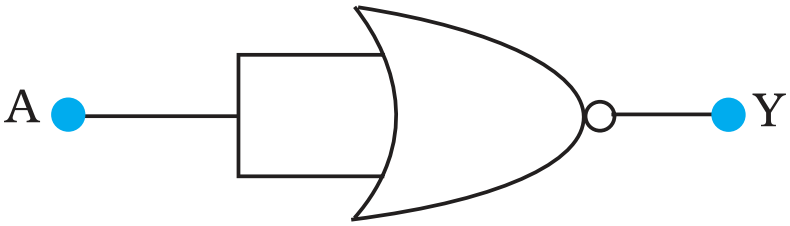
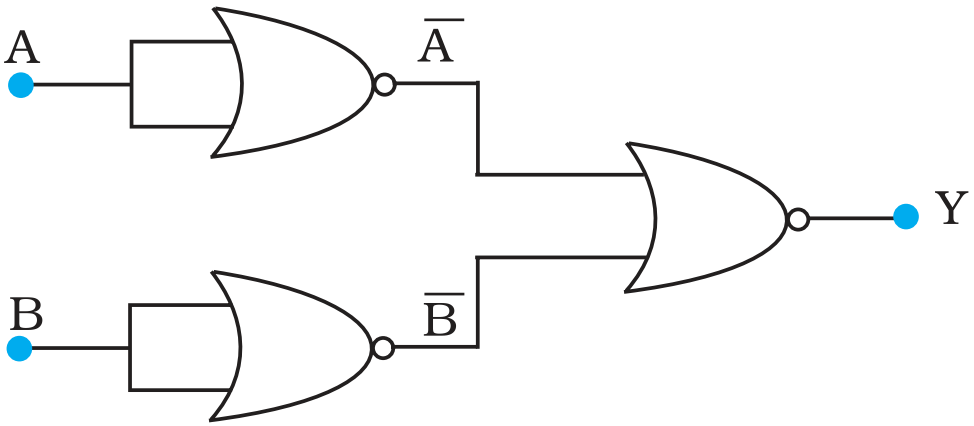
Write the truth table for the circuits given in Fig. 14.48 consisting of NOR gates only. Identify the logic operations (OR, AND, NOT) performed by the two circuits.
  1.  
  1.  
  1. State Ampere's circuital law. Use this law to obtain the expression for the magnetic field inside an air cored toroid of average radius 'r' having 'n' turns per unit length and carrying a steady current I.
  2. An observer to the left of a solenoid of N turns each of cross section area 'A' observes that a steady current I in it flows in the clockwise direction. Depict the magnetic field lines due to the solenoid specifying its polarity and show that it acts as a bar magnet of magnetic moment m = NIA.
A hollow tube has a length $l_1$ inner radius $R_1$ and outer radius $R_2$. The material has a thermal conductivity K. Find the heat flowing through the walls of the tube if.
  1. The flat ends are maintained at temperatures $T_1$ and $T_2(T_2 > T_1)$
  2. The inside of the tube is maintained at temperature $T_1$ and the outside is maintained at $T_2.$
Two monochromatic beams A and B of equal intensity I, hit a screen. The number of photons hitting the screen by beam A is twice that by beam B. Then what inference can you make about their frequencies?
A load resistor of $2\text{k}\Omega$ is connected in the collector branch of an amplifier circuit using a transistor in common-emitter mode. The current gain $\beta=50.$ The input resistance of the transistor is $0.50\text{k}\Omega.$ If the input current is changed by $50\mu\text{A}.$
  1. By what amount does the output voltage change?
  2. By what amount does the input voltage change?
  3. What is the power gain?
Two car garages have a common gate which needs to open automatically when a car enters either of the garages or cars enter both. Devise a circuit that resembles this situation using diodes for this situation.
A coil of resistance $40\Omega$ is connected across a 4.0V battery 0.10s after the battery is connected, the current in the coil is 63mA. Find the inductance of the coil.