An angular magnification (magnifying power) of 30X is desired using an objective of focal length 1.25 cm and an eyepiece of focal length 5 cm. How will you set up the compound microscope?
Exercise
Download our app for free and get started
Focal length of the objective lens, $f_0 = 1.25$ cm
Focal length of the eyepiece, $f_e = 5$ cm
Least distance of distinct vision, $d = 25$ cm
Angular magnification of the compound microscope = 30X
Total magnifying power of the compound microscope, m = 30
The angular magnification of the eyepiece is given by the relation:
$\text{m}_\text{e}=\Big(1+\frac{\text{d}}{\text{f}_\text{e}}\Big)$
$=\Big(1+\frac{25}{5}\Big)=6$
The angular magnification of the objective lens (mo) is related to meas:
$m_e m_e= m$
$\text{m}_0=\frac{\text{m}}{\text{m}_\text{e}}$
$=\frac{30}{6}=5$
We also have the relation:
$\text{m}_0=\frac{\text{image distance for the objective lenc(v}_0)}{\text{image distance for the objective lenc(-u}_0)}$
$5=\frac{\text{v}_0}{\text{-u}_0}$
$\therefore \ \text{v}_0=-5\text{u}_0$
Applying the lens formula for the objective lens.
$\frac{1}{\text{f}_0}=\frac{1}{\text{v}_0}-\frac{1}{\text{u}_0}$
$\frac{1}{1.25}=\frac{1}{-5\text{u}_0}-\frac{1}{\text{u}_0}=\frac{-6}{5\text{u}_0}$
$\therefore \ \text{u}_0=\frac{-6}{5}\times1.25=-1.5 \ \text{cm}$
And, $\text{v}_0=-5\text{u}_0$
$= -5 × (-1.5) = 7.5$ cm
The object should be placed 1.5 cm away from the objective lens to obtain the desired magnification.
Applying the lens formula for the eyepiece:
$\frac{1}{\text{v}_\text{e}}-\frac{1}{\text{u}_\text{e}}=\frac{1}{\text{f}_\text{e}}$
Where, $v_e =$ Image distance for the eyepiece $= -d= -25$ cm
$u_e =$ Object distance for the eyepiece
$\frac{1}{\text{u}_\text{e}}=\frac{1}{\text{v}_\text{e}}-\frac{1}{\text{f}_\text{e}}$
$=-\frac{1}{25}-\frac{1}{5}=\frac{-6}{25}$
$\therefore \ \text{u}_\text{e}=-04.17 \ \text{cm}$
Separation between the objective lens and the eyepiece $=|\text{u}_\text{e}|+|\text{v}_0|$
$= 4.17 + 7.5$
$ = 11.67$ cm
Therefore, the separation between the objective lens and the eyepiece should be 11.67 cm.
Focal length of the eyepiece, $f_e = 5$ cm
Least distance of distinct vision, $d = 25$ cm
Angular magnification of the compound microscope = 30X
Total magnifying power of the compound microscope, m = 30
The angular magnification of the eyepiece is given by the relation:
$\text{m}_\text{e}=\Big(1+\frac{\text{d}}{\text{f}_\text{e}}\Big)$
$=\Big(1+\frac{25}{5}\Big)=6$
The angular magnification of the objective lens (mo) is related to meas:
$m_e m_e= m$
$\text{m}_0=\frac{\text{m}}{\text{m}_\text{e}}$
$=\frac{30}{6}=5$
We also have the relation:
$\text{m}_0=\frac{\text{image distance for the objective lenc(v}_0)}{\text{image distance for the objective lenc(-u}_0)}$
$5=\frac{\text{v}_0}{\text{-u}_0}$
$\therefore \ \text{v}_0=-5\text{u}_0$
Applying the lens formula for the objective lens.
$\frac{1}{\text{f}_0}=\frac{1}{\text{v}_0}-\frac{1}{\text{u}_0}$
$\frac{1}{1.25}=\frac{1}{-5\text{u}_0}-\frac{1}{\text{u}_0}=\frac{-6}{5\text{u}_0}$
$\therefore \ \text{u}_0=\frac{-6}{5}\times1.25=-1.5 \ \text{cm}$
And, $\text{v}_0=-5\text{u}_0$
$= -5 × (-1.5) = 7.5$ cm
The object should be placed 1.5 cm away from the objective lens to obtain the desired magnification.
Applying the lens formula for the eyepiece:
$\frac{1}{\text{v}_\text{e}}-\frac{1}{\text{u}_\text{e}}=\frac{1}{\text{f}_\text{e}}$
Where, $v_e =$ Image distance for the eyepiece $= -d= -25$ cm
$u_e =$ Object distance for the eyepiece
$\frac{1}{\text{u}_\text{e}}=\frac{1}{\text{v}_\text{e}}-\frac{1}{\text{f}_\text{e}}$
$=-\frac{1}{25}-\frac{1}{5}=\frac{-6}{25}$
$\therefore \ \text{u}_\text{e}=-04.17 \ \text{cm}$
Separation between the objective lens and the eyepiece $=|\text{u}_\text{e}|+|\text{v}_0|$
$= 4.17 + 7.5$
$ = 11.67$ cm
Therefore, the separation between the objective lens and the eyepiece should be 11.67 cm.

Download our appand get started for free
Experience the future of education. Simply download our apps or reach out to us for more information. Let's shape the future of learning together!No signup needed.*
Similar Questions
- 1View SolutionIn many experimental set-ups the source and screen are fixed at a distance say D and the lens is movable. Show that there are two positions for the lens for which an image is formed on the screen. Find the distance between these points and the ratio of the image sizes for these two points.
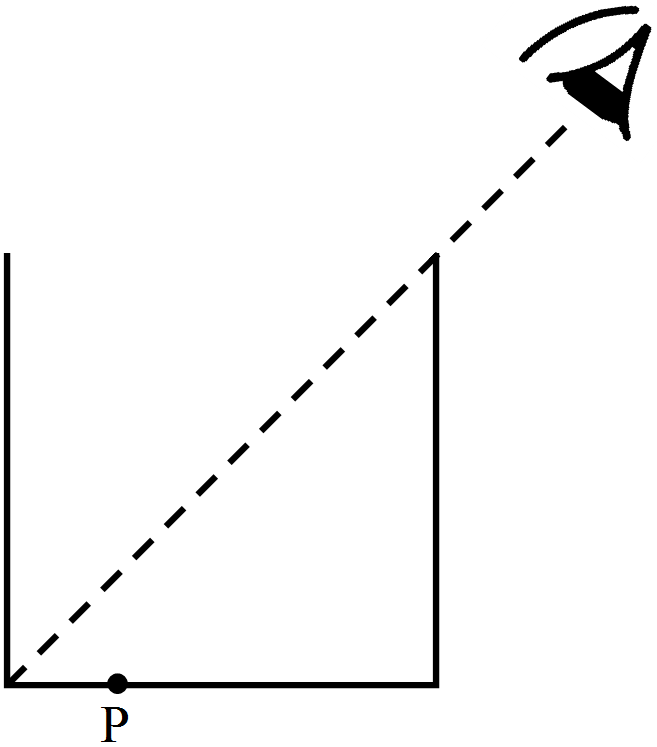
- 2View SolutionA cylindrical vessel, whose diameter and height both are equal to 30cm, is placed on a horizontal surface and a small particle P is placed in it at a distance of 5.0cm from the centre. An eye is placed at a position such that the edge of the bottom is just visible. The particle P is in the plane of drawing. Up to what minimum height should water be poured in the vessel to make the particle P visible?
- 3View SolutionA normal eye has retina 2cm behind the eye-lens. What is the power of the eye-lens when the eye is
- Fully relaxed,
- Most strained?
- 4View SolutionA small bulb is placed at the bottom of a tank containing water to a depth of 80cm. What is the area of the surface of water through which light from the bulb can emerge out? Refractive index of water is 1.33. (Consider the bulb to be a point source).
- 5View SolutionAn astronomical telescope is to be designed to have a magnifying power of 50 in normal adjustment. If the length of the tube is 102cm, find the powers of the objective and the eyepiece.
- 6View SolutionAn optical instrument used for angular magnification has a 25D objective and a 20D eyepiece. The tube length is 25cm when the eye is least strained.
- Whether it is a microscope or a telescope?
- What is the angular magnification produced?
- 7A short object of length L is placed along the principal axis of a concave mirror away from focus. The object distance is u. If the mirror has a focal length f, what will be the length of the image? You may take $L < < |v - f|.$View Solution
- 8View SolutionDraw a ray diagram to show the formation of real image of the same size as that of the object placed in front of a converging lens. Using this ray diagram establish the relation between u, v and f for this lens.
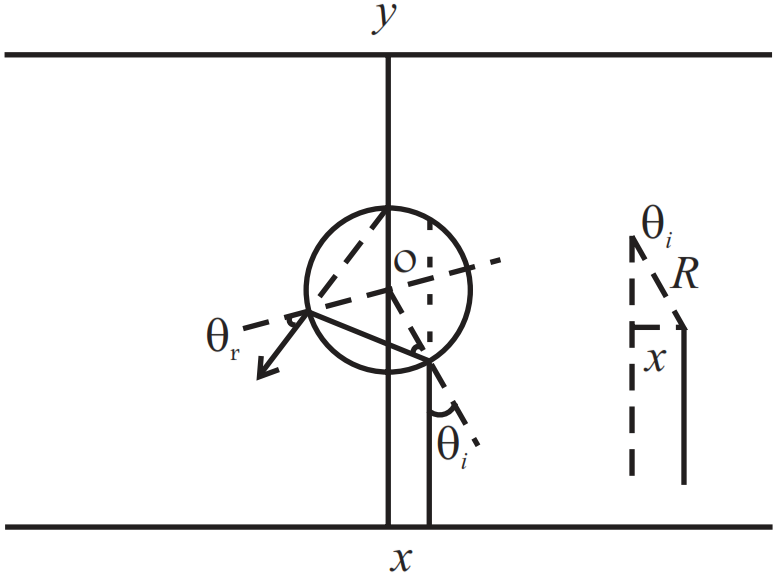
- 9View SolutionAn infinitely long cylinder of radius R is made of an unusual exotic material with refractive index -1 (Fig). The cylinder is placed between two planes whose normals are along the y direction. The center of the cylinder O lies along the y-axis. A narrow laser beam is directed along the y direction from the lower plate. The laser source is at a horizontal distance x from the diameter in the y direction. Find the range of x such that light emitted from the lower plane does not reach the upper plane.
- 10View SolutionDetermine the ‘effective focal length’ of the combination of the two lenses in if they are placed 8.0 cm apart with their principal axes coincident. Does the answer depend on which side of the combination a beam of parallel light is incident? Is the notion of effective focal length of this system useful at all.