Question
A proton and an alpha particle are accelerated through the same potential. Which one of the two has, (i) greater value of de-Broglie wavelength associated with it and (ii) less kinetic energy. Give reasons to justify your answer.

Answer

  1. Proton

$\lambda = \frac{\text{h}}{\sqrt{2\text{mqV}}}$

As mass of proton <mass of $\alpha$ particle and $q_ ∝=2q_p$ 

$\Rightarrow\lambda_{p} > \lambda_{∝}$ for the same accelerating potential.

  1. Alpha particle 

$\text{K.E.} =\text{ qV}$

We have $q_p<q_{\alpha}$ 

$\therefore$ (For same accelerating potential)Kinetic energy of proton < KE of $\alpha$ particle.

Need a full question paper?

Generate a complete, print-ready paper with questions like this in minutes — across 16+ boards, with answer keys.
Start Generating Free

Similar questions

Sound with intensity larger than 120dB appears painful to a person. A small speaker delivers 2.0W of audio output. How close can the person get to the speaker without hurting his ears?
Draw a plot of potential energy of a pair of nucleons as a function of their separation. Write two important conclusions which you can draw regarding the nature of nuclear forces.
Two metallic wires A and B made from same substance have equal lengths and their cross-sections are in the ratio $1: 2$. They are joined in (i) series (ii) parallel. In both the above combinations, compare the drift velocities of electrons in the two wires.
Explain controlled thermonuclear fusion.
Sketch a graph showing variation of reactance of a capacitor with frequency in an AC circuit.
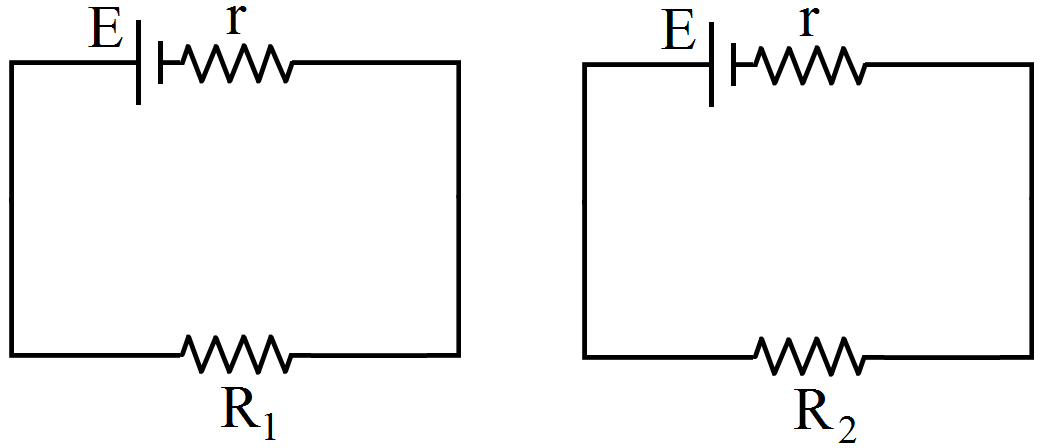
Two unequal resistances R1 and R2 are connected across two identical batteries of emf $\varepsilon$ and internal resistance r. Can the thermal energies developed in R1 and Rbe equal in a given time. If yes, what will be the condition?

Let $\vec{\text{a}}=2\vec{\text{i}}+3\vec{\text{j}}+4\vec{\text{k}}$ and $\vec{\text{b}}=3\vec{\text{i}}+4\vec{\text{j}}+5\vec{\text{k}}.$ Find the angle between them.
A point charge Q is placed at the origin. Find the electrostatic energy stored outside the sphere of radius R centred at the origin.
Why do $\alpha$-particles have high ionising power?
An unruly demonstrator lifts a stone of mass 200g from the ground and throws it at his opponent. At the time of projection, the stone is 150cm above the ground and has a speed of 3.00m/s. Calculate the work done by the demonstrator during the process. If it takes one second for the demonstrator to lift the stone and throw, what horsepower does he use?