MCQ
A proton and an $\alpha - $particle enter a uniform magnetic field perpendicularly with the same speed. If proton takes $25$ $\mu \, sec$ to make $5$ revolutions, then the periodic time for the $\alpha - $ particle would be........$\mu \, sec$
  • A
    $50$
  • B
    $25$
  • $10$
  • D
    $5$

Answer

Correct option: C.
$10$
c
(c) Time period of proton ${T_p} = \frac{{25}}{5} = 5\,\mu \,\sec $
By using $T = \frac{{2\pi \,m}}{{qB}}$$ \Rightarrow $$\frac{{{T_\alpha }}}{{{T_p}}} = \frac{{{m_\alpha }}}{{{m_p}}} \times \frac{{{q_p}}}{{{q_\alpha }}}$$ = \frac{{4{m_p}}}{{{m_p}}} \times \frac{{{q_p}}}{{2{q_p}}}$
$ \Rightarrow \,$ ${T_\alpha } = 2{T_p} = 10\,\mu \,\,\sec .$

Need a full question paper?

Generate a complete, print-ready paper with questions like this in minutes — across 16+ boards, with answer keys.

Start Generating Free

Similar questions

A lens (focal length $50 cm$) forms the image of a distant object which subtends an angle of $1$ milliradian at the lens. What is the size of the image....$mm$
The rest energy of an electron is $0.511 \, MeV$. The electron is accelerated from rest to a velocity $0.5\, c$. The change in its energy will be ............ $MeV$
We have three identical metallic spheres $A, B$ and $C$. $A$ is given a charge $Q$, and $B$ and $C$ are uncharged. The following processes of touching of two spheres are carried out in succession. Each process is carried out with sufficient time.
$(i)$ $A$ and $B$      $(ii)$ $B$ and $C$
$(iii)$ $C$ and $A$      $(iv)$ $A$ and $B$
$(v)$ $B$ and $C$
The final charges on the spheres are
A solid cube and a solid sphere both made of same material are completely submerged in water but to different depths. The sphere and the cube have same surface area. The buoyant force is
The door of a working refrigerator is left open in a well insulated room. The temperature of air in the room will
Which of the following statements regarding magnetic lines of force is correct?
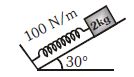
A block of mass $2\,\,kg$ is placed on a rough inclined plane as shown in the figure $(\mu  = 0.2)$ so that it just touches the spring. The block is allowed to move downwards. The spring will be compressed to a maximum of
A particle moving in the $xy$ plane experiences a velocity dependent force $\overrightarrow{ F }= k \left( v _{ y } \hat{ i }+ v _{ x } \hat{ j }\right),$ where $v _{ x }$ and $v _{ y }$ are the $x$ and $y$ components of its velocity $\overrightarrow{ v } .$ If $\overrightarrow{ a }$ be the acceleration of the particle, then which of the following statements is true for the particle$?$
A particle is moving in a straight line. The variation of position ' $x$ ' as a function of time ' $t$ ' is given as $x=\left(t^3-6 t^2+20 t+15\right) m$. The velocity of the body when its acceleration becomes zero is :
By photoelectric effect, Einstein, proved