MCQ
A proton and an electron are accelerated by the same potential difference. Let $\lambda_\text{e}$ and $\lambda_\text{p}$ denote the de Broglie wavelengths of the electron and the proton respectively.
  • A
    $\lambda_\text{e}=\lambda_\text{p}.$
  • B
    $\lambda_\text{e}<\lambda_\text{p}.$
  • $\lambda _\text{e}>\lambda_\text{p}.$
  • D
    The relation between $\lambda_\text{e}$, and $\lambda_\text{p}$ depends on the accelerating potential difference.
Answer

Correct option: C.
$\lambda _\text{e}>\lambda_\text{p}.$
Let $m_e$ and $m_p$ be the masses of electron and proton, respectively.
Let the applied potential difference be $V.$
Thus, the de$-$Broglie wavelength of the electron,
$\lambda=\frac{\text{h}}{\sqrt{2\text{m}_\text{e}\text{eV}}}\dots(1)$
And de$-$Broglie wavelength of the proton,
$\lambda=\frac{\text{h}}{\sqrt{2\text{m}_\text{p}\text{eV}}}\dots(2)$
Dividing equation $(2)$ by equation $(1)$, we get:
$\frac{\lambda_\text{p}}{\lambda_\text{e}}=\frac{\sqrt{\text{m}_\text{e}}}{\sqrt{\text{m}_\text{p}}}$
$\text{m}_\text{e}<\text{m}_\text{p}$
$\therefore\frac{\lambda_\text{p}}{\lambda_\text{e}}<1$
$\Rightarrow\lambda_ \text{p}<\lambda_\text{e}$

Need a full question paper?

Generate a complete, print-ready paper with questions like this in minutes — across 16+ boards, with answer keys.

Start Generating Free

Similar questions

A body of mass $5\,kg$ is moving with a momentum of $10\,kg\,ms ^{-1}$. Now a force of $2\,N$ acts on the body in the direction of its motion for $5\,s$. The increase in the Kinetic energy of the body is $...........J$.
What is the number of significant figures in $ 0.310\times 10^3$
Radius of gyration of a body depends on
Which of the following group have different dimension
The vernier scale used for measurement has a positive zero error of $0.2\, mm$. If while taking a measurement it was noted that $'0'$ on the vernier scale lies between $8.5\, cm$ and $8.6\, cm$ vernier coincidence is $6,$ then the correct value of measurement is ............. $cm$. (least count $=0.01\, cm )$
A tuning fork of frequency $340\,Hz$ resonates in the fundamental mode with an air column of length $125\,cm$ in a cylindrical tube closed at one end. When water is slowly poured in it, the minimum height of water required for observing resonance once again is________ $cm$

(Velocity of sound in air is $340\,ms ^{-1}$ )

If a graph is plotted taking the temperature in Fahrenheit along $Y-$axis and the corresponding temperature in Celsius along the $X-$axis, it will be a straight line
Orbital velocity of an artificial satellite does not depend upon
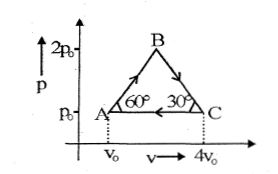
Four moles of an ideal monoatomic gas undergoes a cyclic process $ABCA$ as shown in figure find ratio of temperature of $A$ and $B$ .
Two small spherical metal balls, having equal masses, are made from materials of densities $\rho_{1}$ and $\rho_{2}\left(\rho_{1}=8 \rho_{2}\right)$ and have radii of $1\; \mathrm{mm}$ and $2\; \mathrm{mm}$, respectively. They are made to fall vertically (from rest) in a viscous medum whose coefficient of viscosity equals $\eta$ and whose denstry is $0.1 \mathrm{\rho}_{2} .$ The ratio of their terminal velocitites would be