MCQ
The vernier scale used for measurement has a positive zero error of $0.2\, mm$. If while taking a measurement it was noted that $'0'$ on the vernier scale lies between $8.5\, cm$ and $8.6\, cm$ vernier coincidence is $6,$ then the correct value of measurement is ............. $cm$. (least count $=0.01\, cm )$
  • A
    $8.36$
  • $8.54$
  • C
    $8.58$
  • D
    $8.56$

Answer

Correct option: B.
$8.54$
b
Positive zero error $=0.2 mm$

Main scale reading $=8.5 cm$

Vernier scale reading $=6 \times 0.01=0.06 cm$

Final reading $=8.5+0.06-0.02=8.54 cm$

Need a full question paper?

Generate a complete, print-ready paper with questions like this in minutes — across 16+ boards, with answer keys.

Start Generating Free

Similar questions

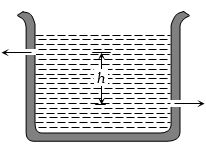
There are two identical small holes of area of cross-section a on the opposite sides of a tank containing a liquid of density $\rho $. The difference in height between the holes is $h$. Tank is resting on a smooth horizontal surface. Horizontal force which will has to be applied on the tank to keep it in equilibrium is
Two solenoids have identical geometrical construction but one is made of thick wire and the other of thin wire. Which of the following quantities are different for the two solenoids?
There are two force vectors, one of $5\, N$ and other of $12\, N $ at what angle the two vectors be added to get resultant vector of $17\, N, 7\, N $ and $13 \,N$ respectively
Wind is blowing west to east along two parallel tracks. Two trains moving with same speed in opposite directions have the steam track of one double then other. The speed of each train is:
A particle is executing simple harmonic motion with a time period $T.$ At time $t = 0$, it is at its position of equilibrium. The kinetic energy-time graph of the particle will look like
Ionization energy of a hydrogen$-$like ion $A$ is greater than that of another hydrogen$-$like ion $B$. Let $r, u, E$ and $L$ represent the radius of the orbit, speed of the electron, energy of the atom and orbital angular momentum of the electron respectively. In ground state:
A car of mass $m$ starts from rest and acquires a velocity along east $\text{v}=\text{v}\hat{\text{i}}(\text{v}>\text{0})$ in two seconds. Assuming the car moves with uniform acceleration, the force exerted on the car is:
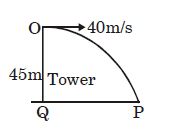
In the figure shown, velocity of the particle at $P \,(g = 10\,m/s^2)$
At constant volume, for different diatomic gases the molar specific heat is
Consider the quantities, pressure, power, energy, impulse, gravitational potential, electrical charge, temperature, area. Out of these, the only vector quantities are