Question
A proton exerts a force on a proton which is:
  1. Gravitational.
  2. Electromagnetic.
  3. Nuclear.
  4. Weak.

Answer

  1. Gravitational
  2. Electromagnetic
  3. Nuclear
Explanation:
A proton exerts gravitational, electromagnetic and nuclear forces on a proton.
The gravitational force can easily be seen everywhere; it the weakest among all the forces. It is negligible in elementary particles like protons.
The electromagnetic force can be seen between charged particles. Since proton is a charged particle, it can exert this force on other protons.
The nuclear force is present only if the interacting particles are protons or neutrons or both. So, this force can exist between two protons.
Need a full question paper?

Generate a complete, print-ready paper with questions like this in minutes — across 16+ boards, with answer keys.

Start Generating Free

Similar questions

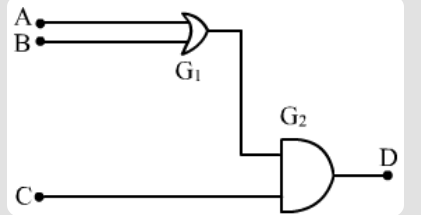
For the given combination of gates, if the logic states of inputs A, B, C are as follows A = B = C = 0 and A = B = 1,C = 0 then the logic states of output D are:
The velocity of emitted electrons in photelectric effect depends :
A charged particle is moved along a magnetic field line. The magnetic force on the particle is:
  1. Along its velocity.
  2. Opposite to its velocity.
  3. Perpendicular to its velocity.
  4. Zero.
Assertion   :   Two electric bulbs of 50 and 100 W are given. When connected in series 50 W bulb glows more but when connected parallel 100 W bulb glows more. 
Reason      : In series combination, power is directly proportional to the resistance of circuit. But in parallel combination, power is inversely proportional to the resistance of the circuit.(a) If both assertion and reason are true and the reason is the correct explanation of the assertion.(b) If both assertion and reason are true but reason is not the correct explanation of the assertion.(c) If assertion is true but reason is false.(d) If the assertion and reason both are false.


A double convex lens of glass of m = 1.5 has radius of curvature of each of its surface is 0.2 m.  The power of the lens is(a) + 10 dioptres (b) – 10 dioptres(c) – 5 dioptres(d)  +5 dioptres
       
Electric potential is equal to :
The interfering fringes formed by a thin oil film on water are seen in yellow light of sodium lamp. We find the fringes:
Which photon is more energetic: A red one or a violet one?
A parallel plate capacitor has capacitance $C.$ If it is equally filled with parallel layers of materials of dielectric constants $K_1$ and $K_2$ its capacity becomes $C_1$. The ratio of $C_1$ to $C $ is
The current density $($number of free electrons per $m^3)$ in metallic conductor is of the order of: