A proton has a mass $1.67 \times 10^{-27} \,kg$ and charge $+1.6 \times 10^{-19} \,C$. If the proton is accelerated through a potential difference of million volts, then the kinetic energy is ......... $J$
Easy


Download our appand get started for free
Experience the future of education. Simply download our apps or reach out to us for more information. Let's shape the future of learning together!No signup needed.*
Similar Questions
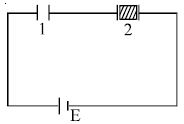
- 1Two identical capacitors $1$ and $2$ are connected in series to a battery as shown in figure. Capacitor $2$ contains a dielectric slab of dielectric constant k as shown. $Q_1$ and $Q_2$ are the charges stored in the capacitors. Now the dielectric slab is removed and the corresponding charges are $Q’_1$ and $Q’_2$. ThenView Solution
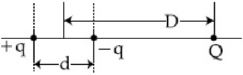
- 2A system of three charges are placed as shown in the figure.View Solution
If $D > > d,$ the potential energy of the system is best given $b$
- 3Three capacitors $1, 2$ and $4\,\mu F$ are connected in series to a $10\,volt$ source. The charge on the plates of middle capacitor isView Solution
- 4View SolutionInside a hollow charged spherical conductor, the potential
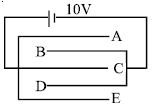
- 5Five identical capacitor plates are arranged such that they make capacitors each of $2\ \mu F$. The plates are connected to a source of $emf$ $10\ V$. The charge on plate $C$ is......$ \mu C$View Solution
- 6Two spherical conductors each of capacity $C$ are charged to potentials $V$ and $ - V$. These are then connected by means of a fine wire. The loss of energy will beView Solution
- 7A short electric dipole has a dipole moment of $16 \times 10^{-9}\, Cm .$ The electric potential due to the dipole at a point at a distance of $0.6\, m$ from the centre of the dipole, situated on a line making an angle of $60^{\circ}$ with the dipole axis is $.........V$View Solution
$\left(\frac{1}{4 \pi \epsilon_{0}}=9 \times 10^{9} Nm ^{2} / C ^{2}\right)$
- 8View SolutionA parallel plate air capacitor is charged and then isolated. When a dielectric material is inserted between the plates of the capacitor, then which of the following does not change
- 9Two charges $ + 3.2 \times {10^{ - 19}}\,C$ and $ - 3.2 \times {10^{ - 19}}\,C$ kept $2.4\, \mathop A\limits^o $ apart forms a dipole. If it is kept in uniform electric field of intensity $4 \times {10^5}\,volt/m$ then what will be its electrical energy in equilibriumView Solution
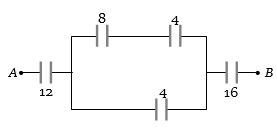
- 10What is the equivalent capacitance between $A$ and $B$ in the given figure (all are in farad)View Solution