A short electric dipole has a dipole moment of $16 \times 10^{-9}\, Cm .$ The electric potential due to the dipole at a point at a distance of $0.6\, m$ from the centre of the dipole, situated on a line making an angle of $60^{\circ}$ with the dipole axis is $.........V$
$\left(\frac{1}{4 \pi \epsilon_{0}}=9 \times 10^{9} Nm ^{2} / C ^{2}\right)$
NEET 2020, Medium
Download our app for free and get started
$V=\frac{k P \cos \theta}{r^{2}}=\frac{9 \times 10^{9} \times 16 \times 10^{-9}}{(0.6)^{2}} \times \frac{1}{2}$
$V=200\, V$

Download our appand get started for free
Experience the future of education. Simply download our apps or reach out to us for more information. Let's shape the future of learning together!No signup needed.*
Similar Questions
- 1Two equal charges $q$ of opposite sign separated by a distance $2a$ constitute an electric dipole of dipole moment $p$. If $P$ is a point at a distance $r$ from the centre of the dipole and the line joining the centre of the dipole to this point makes an angle $\theta $ with the axis of the dipole, then the potential at $P$ is given by $(r > > 2a)$ (Where $p = 2qa$)View Solution
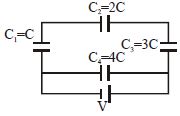
- 2A network of four capacitors of capacity equal to $C_1 = C, C_2 = 2C, C_3 = 3C$ and $C_4 = 4C$ are conducted in a battery as shown in the figure. The ratio of the charges on $C_2$ and $C_4$ isView Solution
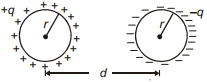
- 3Two similar conducting balls having charges $+q$ and $-q$ are placed at a separation $d$ from each other in air. The radius of each ball is $r$ and the separation between their centres is $d(d > > r)$. Calculate the capacitance of the two ball systemView Solution
- 4There is a uniform electrostatic field in a region. The potential at various points on a small sphere centred at $P$, in the region, is found to vary between in the limits $589.0\,V$ to $589.8\, V$. What is the potential at a point on the sphere whose radius vector makes an angle of $60^o$ with the direction of the field ?........$V$View Solution
- 5A charge $ + q$ is fixed at each of the points $x = {x_0},\,x = 3{x_0},\,x = 5{x_0}$..... $\infty$, on the $x - $axis and a charge $ - q$ is fixed at each of the points $x = 2{x_0},\,x = 4{x_0},x = 6{x_0}$,..... $\infty$. Here ${x_0}$ is a positive constant. Take the electric potential at a point due to a charge $Q$ at a distance $r$ from it to be $Q/(4\pi {\varepsilon _0}r)$. Then, the potential at the origin due to the above system of charges isView Solution
- 6The two thin coaxial rings, each of radius $'a'$ and having charges $+{Q}$ and $-{Q}$ respectively are separated by a distance of $'s'.$ The potential difference between the centres of the two rings is :View Solution
- 7The electric potential at a point on the axis of an electric dipole depends on the distance $r$ of the point from the dipole asView Solution
- 8Capacitance of a parallel plate capacitor becomes $4/3$ times its original value if a dielectric slab of thickness $t = d/2$ is inserted between the plates ($d$ is the separation between the plates). The dielectric constant of the slab isView Solution
- 9Given below are two statements: One is labelled as Assertion $A$ and the other is labelled as Reason $R$.View Solution
Assertion $A:$ Two metallic spheres are charged to the same potential. One of them is hollow and another is solid, and both have the same radii. Solid sphere will have lower charge than the hollow one.
Reason $R:$ Capacitance of metallic spheres depend on the radii of spheres.
In the light of the above statements, choose the correct answer from the options given below.
- 10The plates of a parallel plate capacitor are charged up to $100\, volt$. A $2\, mm$ thick plate is inserted between the plates, then to maintain the same potential difference, the distance between the capacitor plates is increased by $1.6\, mm$. The dielectric constant of the plate isView Solution