MCQ
A proton is about $1840$ times heavier than an electron. When it is accelerated by a potential difference of $1\, kV$, its kinetic energy will be......$keV$
  • A
    $1840$
  • B
    $1/1840$
  • $1$
  • D
    $920$

Answer

Correct option: C.
$1$
c
(c) $KE = QV = e \times 10^3 \,V = 1\,KeV.$

Need a full question paper?

Generate a complete, print-ready paper with questions like this in minutes — across 16+ boards, with answer keys.
Start Generating Free

Similar questions

An electron of stationary hydrogen atom passes from the fifth energy level to the ground  level. The velocity that the atom acquired a result of photon emission will be: ($m$ is the  mass of the atom, $R$ is Rydberg constant and $h$ is Planck's constant) 
A lens placed $10 \,cm$ away from a wall casts a sharp inverted image of a candle on it. It again casts a sharp image when the lens is moved $20 \,cm$ further away from the wall. Now. the candle and the lens are moved such that a sharp inverted image with unit magnification is formed on the wall. To achieve this configuration, the candle was moved
If in a plano-convex lens, the radius of curvature of the convex surface is 10 cm and the focal length of the lens is 30 cm, then the refractive index of the material of lens will be
In which of the following, emission of electrons does not take place?
A battery of $6\, volts$ is connected to the terminals of a three meter long wire of uniform thickness and resistance of the order of $100\,\Omega $. The difference of potential between two points separated by $50\,cm$ on the wire will be .......... $V$
Image formed by a convex mirror is
Electric field and magnetic field in Thomson mass spectrograph are applied
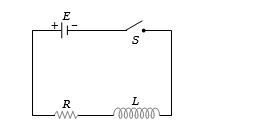
Switch $S$ of the circuit shown in figure. is closed at $t = 0$. If e denotes the induced emf in $L$ and i, the current flowing through the circuit at time $t $, which of the following graphs is correct
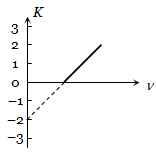
Figure represents a graph of kinetic energy (K) of photoelectrons (in eV) and frequency (v) for a metal used as cathode in photoelectric experiment. The work function of metal is
Molybdenum is used as a target element for production of $X-$ rays because it is