MCQ
A proton is accelerated through $50,000\, V$. Its energy will increase by
  • A
    $5000 \,eV$
  • $8 \times {10^{ - 15}}\,J$
  • C
    $5000 \,J$
  • D
    $50,000\, J$

Answer

Correct option: B.
$8 \times {10^{ - 15}}\,J$
b
(b) Kinetic energy $K = Q.V$ $==>$ $K = (+e) (50000 \,V)$
$= 50000\, eV = 50000 × 1.6 × 10^{-19} \,J = 8 × 10^{-15}\, J$

Need a full question paper?

Generate a complete, print-ready paper with questions like this in minutes — across 16+ boards, with answer keys.
Start Generating Free

Similar questions

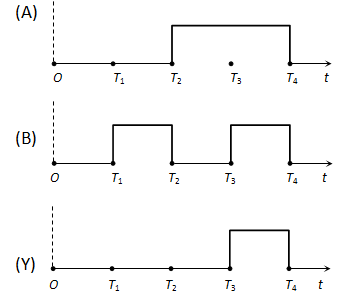
The given figure shows the wave forms for two inputs A and B and that for the output Y of a logic circuit. The logic circuit is
Statement $-1$ : When a magnet is made to fall freely through a closed coil, its acceleration is always less than acceleration due to gravity.

and

Statement $-2$ : Current induced in the coil opposes the motion of the magnet, as per Lenz's law.
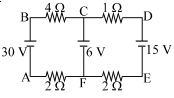
The figure shows a network of four resistances and three batteries Which of the battery is getting charged.
Demagnetisation of magnets can be done by
A body is in pure rotation. The linear speed $\nu$ of a particle, the distance r of the particle from the axis and the angular velocity $\omega$ of the body are related as $\omega=\frac{\text{v}}{\text{r}}$ Thus:
How will the diffraction pattern change when yellow light is replaced by blue light? The fringe will be :-
200 MeV of energy may be obtained per fission of $\mathrm{U}^{235}$. A reactor is generating 1000 kW of power. The rate of nuclear fission in the reactor is
An electron of stationary hydrogen atom passes from the fifth energy level to the ground  level. The velocity that the atom acquired a result of photon emission will be: ($m$ is the  mass of the atom, $R$ is Rydberg constant and $h$ is Planck's constant) 
A plane electromagnetic wave of frequency $100\, MHz$ is travelling in vacuum along the $x -$ direction. At a particular point in space and time, $\overrightarrow{ B }=2.0 \times 10^{-8} \hat{ k } T$. (where, $\hat{ k }$ is unit vector along $z-$direction) What is $\overrightarrow{ E }$ at this point ?
A magnet of magnetic moment $ 20 $ $C.G.S.$  units is freely suspended in a uniform magnetic field of intensity $0.3 $ $ C.G.S.$ units. The amount of work done in deflecting it by an angle of $30°$ in $ C.G.S.$  units is