A proton (mass $ = 1.67 \times {10^{ - 27}}\,kg$ and charge $ = 1.6 \times {10^{ - 19}}\,C)$ enters perpendicular to a magnetic field of intensity $2$ $weber/{m^2}$ with a velocity $3.4 \times {10^7}\,m/\sec $. The acceleration of the proton should be
Medium
Download our app for free and get started
(a) $F = ma = qvB$ $==>$ $a = \frac{{qvB}}{m} = \frac{{1.6 \times {{10}^{ - 19}} \times 2 \times 3.4 \times {{10}^7}}}{{1.67 \times {{10}^{ - 27}}}}$
$=$ $6.5 \times {10^{15}}\,m/{\sec ^2}$

Download our appand get started for free
Experience the future of education. Simply download our apps or reach out to us for more information. Let's shape the future of learning together!No signup needed.*
Similar Questions
- 1Two mutually perpendicular conductors carrying currents $I_1$ and $I_2$ lie in one plane. Locus of the point at which the magnetic induction is zero, is aView Solution
- 2Two thin, long, parallel wires, separated by a distance ‘$d$’ carry a current of ‘$i$’ in the same direction. They willView Solution
- 3A long solenoid has $n$ turns per meter and current $I\, A$ is flowing through it. The magnetic field at the ends of the solenoid isView Solution
- 4Two particles $\mathrm{X}$ and $\mathrm{Y}$ having equal charges are being accelerated through the same potential difference. Thereafter they enter normally in a region of uniform magnetic field and describes circular paths of radii $R_1$ and $R_2$ respectively. The mass ratio of $\mathrm{X}$ and $\mathrm{Y}$ is :View Solution
- 5Two parallel wires in free space are $10\, cm$ apart and each carries a current of $10\, A$ in the same direction. The force one wire exerts on the other per metre of length isView Solution
- 6The dipole moment of a circular loop carrying a current $I$, is $m$ and the magnetic field at the centre of the loop is $B_1$ . When the dipole moment is doubled by keeping the current constant, the magnetic field at the centre of the loop is $B_2$ . The ratio $\frac{{{B_1}}}{{{B_2}}}$ isView Solution
- 7A $50\, ohm$ galvanometer gets full scale deflection when a current of $0.01\, A$ passes through the coil. When it is converted to a $10\, A$ ammeter, the shunt resistance is ........... $\Omega $View Solution
- 8View SolutionWhich of the following statement is correct :
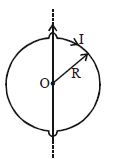
- 9A circular conducting loop of radius $R$ carries a current $I.$ Another straight infinite conductor carrying current $I$ passes through the diameter of this loop as shown in the figure. The magnitude of force exerted by the straight conductor on the loop isView Solution
- 10View SolutionIf a positive ion is moving, away from an observer with same acceleration, then the lines of force of magnetic induction will be