Two parallel wires in free space are $10\, cm$ apart and each carries a current of $10\, A$ in the same direction. The force one wire exerts on the other per metre of length is
AIPMT 1997, Medium


Download our appand get started for free
Experience the future of education. Simply download our apps or reach out to us for more information. Let's shape the future of learning together!No signup needed.*
Similar Questions
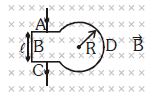
- 1The figure shows a conducting loop $ABCDA$ placed in a uniform magnetic field perpendicular to its plane. The part $ABC$ is the $(3/4)^{th}$ portion of the square of side length $l$ . The part $ADC$ is a circular arc of radius $R$ . The points $A$ and $C$ are connected to a battery which supply a current $I$ to the circuit. The magnetic force on the loop due to the field $B$ isView Solution
- 2${H^ + },\,H{e^ + }$ and ${O^{ + + }}$ ions having same kinetic energy pass through a region of space filled with uniform magnetic field $B$ directed perpendicular to the velocity of ions. The masses of the ions ${H^ + },\,H{e^ + }$and ${O^{ + + }}$ are respectively in the ratio $1:4:16$. As a resultView Solution
- 3A galvanometer having a resistance of $20\,\Omega $ and $30\, divisions$ on both sides has figure of merit $0.005\, ampere /division$. The resistance that should be connected in series such that it can be used as a voltmeter upto $15\, volt$ is ........... $\Omega$View Solution
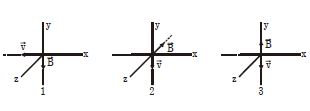
- 4The figure shows three situations when an electron with velocity $\vec v$ travels through a nuniform magnetic field $\vec B$ . In each case, what is the direction of magnetic force on the electron?View Solution
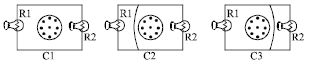
- 5A solenoid is oriented end-on so that its opening is perpendicular to the circuit containing the two light bulbs as drawn in figure $C_1.$ For figure $C_2$ and $C_3,$ a shorting wire of negligible resistance is added as shown. Assume that the magnetic field from the solenoid, shown coming out of the plane of the page, decreases uniformly with time at the same rate for each circuit. Rank the circuits for the brightness of the bulb labeled $R_1$ from brightest to dimmest.View Solution
- 6The force exerted by a magnetic field on a wire having length $L$ and current $I$ is perpendicular to the wire and given as $\left| F \right| = IL\left| B \right|$ . An experimental plot shows $(\vec F)$ as function of $L$ . The plot is a straight line with a slope $S = \left( {10 \pm 1} \right) \times {10^{ - 5}}\ AT$. The current in the wire is $\left( {15 \pm 1} \right)\ mA$ . The percentage error in $B$ isView Solution
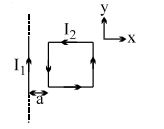
- 7A square loop of side $\lambda $ is placed in the neighbourhood of an infinitely long straight wire carrying a current $I_1.$ The loop carries a current $I_2$ as shown in figureView Solution
- 8A particle with ${10^{ - 11}}\,coulomb$ of charge and ${10^{ - 7}}\,kg$ mass is moving with a velocity of ${10^8}\,m/s$ along the $y$-axis. A uniform static magnetic field $B = 0.5\,Tesla$ is acting along the $x$-direction. The force on the particle isView Solution
- 9To convert a $800\, mV$ range milli voltmeter of resistance $40 \,\Omega$ into a galvanometer of $100\, mA$ range, the resistance to be connected as shunt is .............. $\Omega $View Solution
- 10A circular coil of radius $4\, cm$ has $50$ $turns$. In this coil a current of $2\, A$ is flowing. It is placed in a magnetic field of $0.1$ $weber/{m^2}$. The amount of work done in rotating it through $180^\circ $ from its equilibrium position will be........$J$View Solution