MCQ
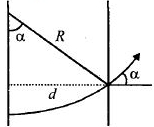
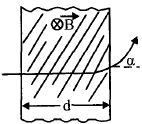
A proton (mass $m$ ) accelerated by a potential difference $V$  flies through a uniform transverse magnetic field $B.$ The field occupies a region of space by width $'d'$. If $\alpha $ be the angle of deviation of proton from initial direction of motion (see figure), the value of $sin\,\alpha $ will be
  • A
    $qV\,\sqrt {\frac{{Bd}}{{2m}}} $
  • B
    $\frac{B}{2}\sqrt {\frac{{qd}}{{mV}}} $
  • C
    $\frac{B}{d}\sqrt {\frac{{q}}{{2mV}}} $
  • $Bd\sqrt {\frac{q}{{2mV}}} $

Answer

Correct option: D.
$Bd\sqrt {\frac{q}{{2mV}}} $
d
From figure, $sin\,\alpha =dlR$

And we know, $\frac{m v^{2}}{R}=q v B$

$\Rightarrow \quad R=\frac{m v}{q B}$

$\because \sin \alpha=\frac{d q B}{m v}$

$\sin \alpha=B d \sqrt{\frac{q}{2 m V}}\left[\because q V=\frac{1}{2} m v^{2}\right]$

Need a full question paper?

Generate a complete, print-ready paper with questions like this in minutes — across 16+ boards, with answer keys.

Start Generating Free

Similar questions

In an ideal parallel $LC$ circuit, the capacitor is charged by connecting it to a $D.C.$ source which is then disconnected. The current in the circuit.
A block of mass M is hanging over a smooth and light pulley through a light string. T he other end of the string is pulled by a constant force F. The kinetic energy of the block increases by 20J in 1s.
The electrons are emitted in the photoelectric effect from a metal surface
The capacity of a parallel plate condenser is $C$. Its capacity when the separation between the plates is halved will be
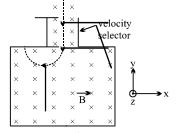
Two charged particle $A$ and $B$ each of charge $+e$ and masses $12$ $amu$ and $13$ $amu$ respectively follow a circular trajectory in chamber $X$ after the velocity selector as shown in the figure. Both particles enter the velocity selector with speed $1.5 \times 10^6 \,ms^{-1}.$ A uniform magnetic field of strength $1.0$ $T$ is maintained within the chamber $X$ and in the velocity selector.
The potential difference between $A$ and $B$ in the Figure is ................... $\mathrm{V}$
A radioactive material decays by simultaneous emissions of two particles with half lives of $1400\, years$ and $700\, years$ respectively. What will be the time after which one third of the material remains? (Take In $3=1.1$ ) (In $years$)
If the electric potential at any point $(x, y, z) \,m$ in space is given by $V =3 x ^{2}$ volt. The electric field at the point $(1,0,3) \,m$ will be ............
Let $T_a$ and $T_b$ be the final temperatures of the samples $A$ and $B$, respectively, in the previous question.
Check the incorrect statement: When a magnet is moved into a coil the strength of the current depends on: