A proton (or charged particle) moving with velocity $v$ is acted upon by electric field $E$ and magnetic field $B$. The proton will move undeflected if
Easy
Download our app for free and get started
(c) In this case $|\overrightarrow {{F_e}} |\; = \;|\overrightarrow {{F_m}} |$ and both forces are opposite to each other.

Download our appand get started for free
Experience the future of education. Simply download our apps or reach out to us for more information. Let's shape the future of learning together!No signup needed.*
Similar Questions
- 1An electron is accelerated by a potential difference of $12000\, volts$. It then enters a uniform magnetic field of ${10^{ - 3}}\,T$ applied perpendicular to the path of electron. Find the radius of path. Given mass of electron $ = 9 \times {10^{ - 31}}\,kg$ and charge on electron $ = 1.6 \times {10^{ - 19}}\,C$View Solution
- 2$PQRS$ is a square loop made of uniform conducting wire the current enters the loop at $P$ and leaves at $S$. Then the magnetic field will beView Solution
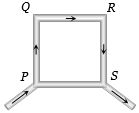
- 3A straight wire carrying a current ${i_1}\,amp$ runs along the axis of a circular current ${i_2}\,amp$. Then the force of interaction between the two current carrying conductors isView Solution
- 4In a hydrogen atom, an electron moves in a circular orbit of radius $5.2 \times {10^{ - 11}}\,m$ and produces a magnetic induction of $12.56\, T$ at its nucleus. The current produced by the motion of the electron will be (Given ${\mu _0} = 4\pi \times {10^{ - 7}}\,Wb/A - m)$View Solution
- 5A wire carrying a current $I$ along the positive $x$-axis has length $L$ It is kept in a magnetic field $\overrightarrow{ B }=(2 \hat{ i }+3 \hat{ j }-4 \hat{ k }) T$. The magnitude of the magnetic force acting on the wire is $..........IL$View Solution
- 6A galvanometer of resistance $20 \,\Omega$ is to be converted into an ammeter of range $1\, A$. If a current of $1\, mA$ produces full scale deflection, the shunt required for the purpose is ................ $\Omega $View Solution
- 7In a certain region static electric and magnetic fields exist. The magnetic field is given by $\vec B = {B_0}\left( {\hat i + 2\hat j - 4\hat k} \right)$. If a test charge moving with a velocity $\vec v = {v_0}\left( {3\hat i - \hat j + 2\hat k} \right)$ experiences no force in that region, then the electric field in the region, in $SI\, units$, isView Solution
- 8The current sensitivity of a moving coil galvanometer increases by $20 \%$ when its resistance is doubled. Calculate, by what factor does the voltage sensitivity change?View Solution
- 9A particle of mass $'m'$ and carrying a charge $'q'$ enters with a velocity $'v'$ perpendicular to a uniform magnetic field. The time period of rotation of the particleView Solution
- 10A moving coil galvanometer has $150$ equal divisions. Its current sensitivity is $10$ divisions per milliampere and voltage sensitivity is $2$ divisions per millivolt. In order that each division reads $1\, volt$, the resistance in $ohms$ needed to be connected in series with the coil will beView Solution