In a certain region static electric and magnetic fields exist. The magnetic field is given by $\vec B = {B_0}\left( {\hat i + 2\hat j - 4\hat k} \right)$. If a test charge moving with a velocity $\vec v = {v_0}\left( {3\hat i - \hat j + 2\hat k} \right)$ experiences no force in that region, then the electric field in the region, in $SI\, units$, is
JEE MAIN 2017, Medium
Download our app for free and get started
According to question, as the test charge experiences no net force in that region i.e., sum of electric force $\left( {{{\text{F}}_{\text{e}}} = {\text{q}}\overrightarrow {\text{E}} } \right)\,$ and magnetic forces $[{{\text{F}}_{\text{m}}} = {\text{q}}(\overline {\text{v}} \times \overline {\text{B}} ]$ will be zero.
Hence, $F_{e}+F_{m}=0$
$\mathrm{F}_{\mathrm{e}}=-\mathrm{q}(\overline{\mathrm{v}} \times \overline{\mathrm{B}})$
$=-\mathrm{B}_{0} \mathrm{v}_{0}[(3 \hat{\mathrm{i}}-\hat{\mathrm{j}}+2 \hat{\mathrm{k}}) \times(\mathrm{i}+2 \hat{\mathrm{j}}-4 \hat{\mathrm{k}})]$
$=-B_{0} v_{0}(14 \hat{j}+7 \hat{k})$

Download our appand get started for free
Experience the future of education. Simply download our apps or reach out to us for more information. Let's shape the future of learning together!No signup needed.*
Similar Questions
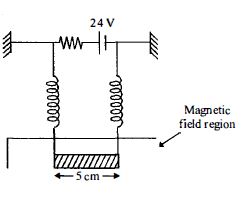
- 1The circuit in figure consists of wires at the top and bottom and identical springs as the left and right sides. The wire at the bottom has a mass of $10\, g$ and is $5\, cm$ long. The wire is hanging as shown in the figure. The springs stretch $0.5\, cm$ under the weight of the wire and the circuit has a total resistance of $12\, \Omega $. When the lower wire is subjected to a static magnetic field, the springs, stretch an additional $0.3\, cm$. The magnetic field isView Solution
- 2An $\alpha$-particle (mass $4 amu$ ) and a singly charged sulfur ion (mass $32 amu$ ) are initially at rest. They are accelerated through a potential $V$ and then allowed to pass into a region of uniform magnetic field which is normal to the velocities of the particles. Within this region, the $\alpha$-particle and the sulfur ion move in circular orbits of radii $r_\alpha$ and $r_5$, respectively. The ratio $\left(r_s / r_\alpha\right)$ is. . . . .$(4)$View Solution
- 3View SolutionAn electron is travelling horizontally towards east. A magnetic field in vertically downward direction exerts a force on the electron along
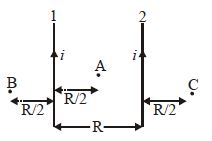
- 4Two long parallel wires are at a distance $R$ apart. They carry steady equal currents in the same directions as shown in the figure. The ratio of magnetic fields at $A, B$ and $C$ respectively, isView Solution
- 5Two charged particles traverse identical helical paths in a completely opposite sense in a uniform magnetic field $B$ = $B_0\hat{k}$View Solution
- 6A $2\, MeV$ proton is moving perpendicular to a uniform magnetic field of $2.5\, tesla$. The force on the proton isView Solution
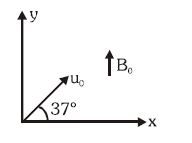
- 7At $t$ = $0$, a positively charged particle of mass $m$ is projected from the origin with velocity $u_0$ at an angle $37^o $ from the $x-$axis as shown in the figure. A constant magnetic field ${\vec B_0} = {B_0}\hat j$ is present in space. After a time interval $t_0$ velocity of particle may be:-View Solution
- 8Two particles $A$ and $B$ having equal charges $+6\,C$, after being accelerated through the same potential difference, enter in a region of uniform magnetic field and describe circular paths of radii $2\,cm$ and $3\,cm$ respectively. The ratio of mass of $A$ to that of $B$ isView Solution
- 9$A$ and $B$ are two conductors carrying a current $i$ in the same direction. $x$ and $y$ are two electron beams moving in the same directionView Solution
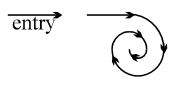
- 10Acharged particle enters a uniform magnetic field perpendicular to its initial direction travelling in air. The path of the particle is seen to follow the path in figure. Which of statements $1-3$ is/are correct?View Solution
$[1]$ The magnetic field strength may have been increased while the particle was travelling in air
$[2]$ The particle lost energy by ionising the air
$[3]$ The particle lost charge by ionising the air