A proton (or charged particle) moving with velocity $v$ is acted upon by electric field $E$ and magnetic field $B$. The proton will move undeflected if
Easy


Download our appand get started for free
Experience the future of education. Simply download our apps or reach out to us for more information. Let's shape the future of learning together!No signup needed.*
Similar Questions
- 1A long copper tube of inner radius $R$ carries a current $i$. The magnetic field $B$ inside the tube isView Solution
- 2An electron of mass $m$ and charge $q$ is travelling with a speed $v$ along a circular path of radius $r$ at right angles to a uniform of magnetic field $B$. If speed of the electron is doubled and the magnetic field is halved, then resulting path would have a radius ofView Solution
- 3A conductor of length $l$ and mass $m$ is placed along the east-west line on a table. Suddenly a certain amount of charge is passed through it and it is found to jump to a height $h$. The earth’s magnetic induction is $B$. The charge passed through the conductor is:View Solution
- 4A current of $2\, amp$. flows in a long, straight wire of radius $2\, mm$. The intensity of magnetic field on the axis of the wire isView Solution
- 5If the strength of the magnetic field produced $10\,cm$ away from a infinitely long straight conductor is ${10^{ - 5}}\,Weber/{m^2}$, the value of the current flowing in the conductor will be........$ampere$View Solution
- 6Charge $q$ is uniformly spread on a thin ring of radius $R.$ The ring rotates about its axis with a uniform frequency $f\, Hz.$ The magnitude of magnetic induction at the center of the ring isView Solution
- 7Consider the two idealised systems $(i)$ a parallel plate capacitor with large plates and small separation and $(ii)$ a long solenoid of length $L >> R$, radius of cross-section. In $(i)\, E$ ideally treated as a constant between plates and zero outside. In $(ii)$ magnetic field is constant inside the solenoid and zero outside. These idealised assumptions, however, contradict fundamental laws as belowView Solution
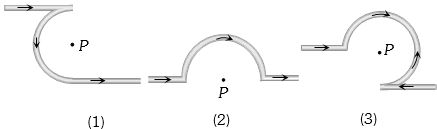
- 8The magnetic field at the centre of a circular coil of radius $r$ is $\pi $ times that due to a long straight wire at a distance $r$ from it, for equal currents. Figure here shows three cases : in all cases the circular part has radius $r$ and straight ones are infinitely long. For same current the $B$ field at the centre $P$ in cases $1$, $2$, $ 3$ have the ratioView Solution
- 9Given below are two statements$:$View Solution
Statement $I:$ Biot-Savart's law gives us the expression for the magnetic field strength of an infinitesimal current element (IdI) of a current carrying conductor only.
Statement $II :$ Biot-Savart's law is analogous to Coulomb's inverse square law of charge $q$, with the former being related to the field produced by a scalar source, Idl while the latter being produced by a vector source, $q$. In light of above statements choose the most appropriate answer from the options given below:
- 10A square loop of edge length $2 \mathrm{~m}$ carrying current of $2 \mathrm{~A}$ is placed with its edges parallel to the $\mathrm{x}-\mathrm{y}$ axis. A magnetic field is passing through the $x-y$ plane and expressed as $\vec{B}=B_0(1+4 x) \hat{k}$, where $\mathrm{B}_0=5 \mathrm{~T}$. The net magnetic force experienced by the loop is. . . . . . . $\mathrm{N}$.View Solution