The magnetic field at the centre of a circular coil of radius $r$ is $\pi $ times that due to a long straight wire at a distance $r$ from it, for equal currents. Figure here shows three cases : in all cases the circular part has radius $r$ and straight ones are infinitely long. For same current the $B$ field at the centre $P$ in cases $1$, $2$, $ 3$ have the ratio
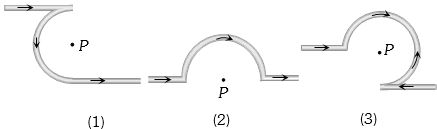
Diffcult
Download our app for free and get started
(a) Case $1$ : ${B_A} = \frac{{{\mu _0}}}{{4\pi }}.\frac{i}{r} \otimes $
${B_B} = \frac{{{\mu _0}}}{{4\pi }}.\frac{{\pi \,i}}{r}\odot$
${B_C} = \frac{{{\mu _0}}}{{4\pi }}.\frac{i}{r}\odot$
So net magnetic field at the centre of case $1$
${B_1} = {B_B} - {B_C} - {B_A} \Rightarrow {B_1} = \frac{{{\mu _0}}}{{4\pi }}.\frac{{\pi i}}{r}\odot$..... $(i)$
Case $2$ : As we discussed before magnetic field at the centre $O$ in this case
${B_2} = \frac{{{\mu _0}}}{{4\pi }}.\frac{{\pi i}}{r} \otimes $ ..... $(ii)$
Case $3$ : ${B_A} = 0$ ${B_B} = \frac{{{\mu _0}}}{{4\pi }}.\frac{{(2\pi - \pi /2)i}}{r} \otimes $
${B_C} = \frac{{{\mu _0}}}{{4\pi }}.\frac{i}{r}\odot$
$ = \frac{{{\mu _0}}}{{4\pi }}.\frac{{3\pi i}}{{2r}} \otimes $
So net magnetic field at the centre of case $3$ ${B_3} = \frac{{{\mu _0}}}{{4\pi }}.\frac{i}{r}\left( {\frac{{3\pi }}{2} - 1} \right) \otimes $..... $(iii)$
From equation $(i)$, $(ii)$ and $(iii)$
${B_1}:{B_2}:{B_3} = \pi \odot$ : $\pi \otimes $ $\left( {\frac{{3\pi }}{2} - 1} \right)\, \otimes = - \frac{\pi }{2}:\frac{\pi }{2}:\left( {\frac{{3\pi }}{4} - \frac{1}{2}} \right)$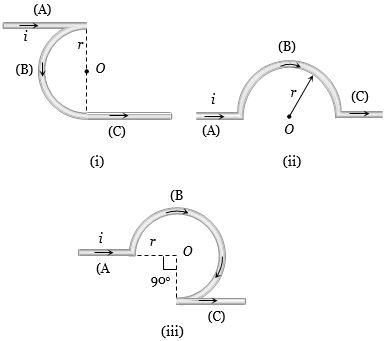

Download our appand get started for free
Experience the future of education. Simply download our apps or reach out to us for more information. Let's shape the future of learning together!No signup needed.*
Similar Questions
- 1The magnetic field at the centre of a circular current carrying-conductor of radius $r$ is $B_c$. The magnetic field on its axis at a distance $r$ from the centre is $B_a$. The value of $B_c$ : $B_a$ will beView Solution
- 2A charge $Q$ is uniformly distributed over the surface of nonconducting disc of radius $R$. The disc rotates about an axis perpendicular to its plane and passing through its centre with an angular velocity $\omega$. As a result of this rotation a magnetic field ofinduction $B$ is obtained at the centre of the disc. If we keep both the amount of charge placed on the disc and its angular velocity to be constant and vary the radius of the disc then the variation of the magnetic induction at the centre of the disc will be represented by the figureView Solution
- 3A circular coil is in $y-z$ plane with centre at the origin. The coil is carrying a constant current. Assuming direction of magnetic field at $x = -25\, cm$ to be positive direction of magnetic field, which of the following graphs shows variation of magnetic field along $x-$ axisView Solution
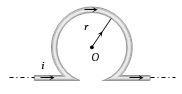
- 4An infinitely long straight conductor is bent into the shape as shown in the figure. It carries a current of $i$ $ampere$ and the radius of the circular loop is $r$ $metre$. Then the magnetic induction at its centre will beView Solution
- 5The current flowing through a coil of resistance $900\, ohms $ is to be reduced by $90\,\%$. What value of shunt should be connected across the coil ............. $\Omega $View Solution
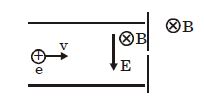
- 6Consider the mass-spectrometer as shown in figure. The electric field between plates is $\vec E\ V/m$ , and the magnetic field in both the velocity selector and in the deflection chamber has magnitude $B$ . Find the radius $'r'$ for a singly charged ion of mass $'m'$ in the deflection chamberView Solution
- 7A moving coil galvanometer, having a resistance $G$, produces full scale deflection when a current $I_g$ flows through it. This galvanometer can be converted into $(i)$ an ammeter of range $0$ to $I_0 (I_0 > I_g)$ by connecting a shunt resistance $R_A$ to it and $(ii)$ into a voltmeter of range $0$ to $V(V = GI_0)$ by connecting a series resistance $R_V$ to it. Then,View Solution
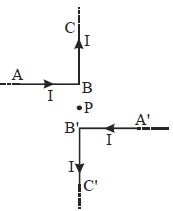
- 8Current through $ABC$ and $A'B'C'$ is $I$. What is the magentic field at $P$ ? $BP = PB' = r$ (Here $C'B'PBC$ are collinear)View Solution
- 9The deflection in moving coil galvanometer falls from $25$ divisions to $5$ division when a shunt of $24\ \Omega$ is applied. The resistance of galvanometer coil will be :View Solution
- 10A moving coil galvanometer has $48$ $turns$ and area of coil is $4 \times {10^{ - 2}}\,{m^2}.$ If the magnetic field is $0.2\, T$, then to increase the current sensitivity by $25\%$ without changing area $(A)$ and field $(B)$ the number of turns should becomeView Solution