A proton with a kinetic energy of $2.0\,eV$ moves into a region of uniform magnetic field of magnitude $\frac{\pi}{2} \times 10^{-3}\,T$. The angle between the direction of magnetic field and velocity of proton is $60^{\circ}$. The pitch of the helical path taken by the proton is $..........cm$ (Take, mass of proton $=1.6 \times 10^{-27}\,kg$ and Charge on proton $=1.6 \times 10^{-19}\,kg)$
JEE MAIN 2023, Medium
Download our app for free and get started
$B=\frac{\pi}{2} \times 10^{-3}$
$K E=\frac{1}{2} m V^2$
$\Rightarrow V=\sqrt{\frac{2 K E}{m}}$
$=v \cos 60^{\circ} \times \frac{2 \pi m}{e B}$
$=\sqrt{\frac{2 \times 2 \times 1.6 \times 10^{-19}}{1.6 \times 10^{-27}}} \times \cos 60^{\circ} \times \frac{2 \pi \times 1.6 \times 10^{-27}}{1.6 \times 10^{-19} \times \frac{\pi}{2} \times 10^{-3}}$
$=2 \times 10^4 \times \frac{1}{2} \times 4 \times 10^{-5}$
$=4 \times 10^{-1} m =40\,cm$

Download our appand get started for free
Experience the future of education. Simply download our apps or reach out to us for more information. Let's shape the future of learning together!No signup needed.*
Similar Questions
- 1View SolutionAssertion : If the current in a solenoid is reversed in direction while keeping the same magnitude, the magnetic field energy stored in the solenoid decreases.
Reason : Magnetic field energy density is proportional to square of current.
- 2A galvanometer has $36\,\Omega $ resistance. If a $4\,\Omega $ shunt is added to this, the fraction of current that passes through the shunt isView Solution
- 3A circular coil of $30$ turns and radius $8.0\, cm$ carrying a current of $6.0\, A$ is suspended vertically in a uniform horizontal magnetic field of magnitude $1.0\, T$. The field lines make an angle of $60^o$ with the normal of the coil. Calculate the magnitude of the counter torque that must be applied to prevent the coil from turning.....$Nm$View Solution
- 4View SolutionAn electron is projected along the axis of a circular conductor carrying some current. Electron will experience force
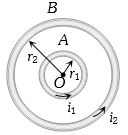
- 5$A$ and $B$ are two concentric circular conductors of centre $O$ and carrying currents ${i_1}$ and ${i_2}$ as shown in the adjacent figure. If ratio of their radii is $1 : 2$ and ratio of the flux densities at $O$ due to $A$ and $B$ is $1 : 3$, then the value of ${i_1}/{i_2}$ isView Solution
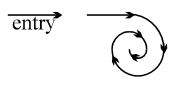
- 6Acharged particle enters a uniform magnetic field perpendicular to its initial direction travelling in air. The path of the particle is seen to follow the path in figure. Which of statements $1-3$ is/are correct?View Solution
$[1]$ The magnetic field strength may have been increased while the particle was travelling in air
$[2]$ The particle lost energy by ionising the air
$[3]$ The particle lost charge by ionising the air
- 7Two parallel wires in the plane of the paper are distance $X _0$ apart. A point charge is moving with speed $u$ between the wires in the same plane at a distance $X_1$ from one of the wires. When the wires carry current of magnitude $I$ in the same direction, the radius of curvature of the path of the point charge is $R_1$. In contrast, if the currents $I$ in the two wires have direction opposite to each other, the radius of curvature of the path is $R_2$.View Solution
If $\frac{x_0}{x_1}=3$, the value of $\frac{R_1}{R_2}$ is.
- 8Two long current carrying conductors are placed parallel to each other at a distance of $8 \,cm$ between them. The magnitude of magnetic field produced at mid-point between the two conductors due to current flowing in them is $300 \,\mu T$. The equal current flowing in the two conductors is ...............View Solution
- 9In toroid magnetic field on axis will be the radius $=0.5\, cm ,$ current $=1.5\, A ,$ turns $=250,$ permeability $=700$ (in Tesla)View Solution
- 10A charged particle going around in a circle can be considered to be a current loop. A particle of mass $m$ carrying charge $q$ is moving in a plane with speed $v$ under the influence of magnetic field $\overrightarrow{ B }$. The magnetic moment of this moving particleView Solution