MCQ
A pulley fixed to the ceilling carries a string with blocks of mass $m$ and $3 \,m$ attached to its ends. The masses of string and pulley are negligible. When the system is released, its centre of mass moves with what acceleration
  • A
    $0$
  • $g/4$
  • C
    $g/2$
  • D
    $ - g/2$

Answer

Correct option: B.
$g/4$
b
$a=\frac{3 m g-m g}{3 m+m}=\frac{g}{2}$

$a_{c . m .}=\frac{m_1 a_1+m_2 a_2}{m_1+m_2}=\frac{3 m\left(\frac{g}{2}\right)+m\left(\frac{g}{2}\right)}{3 m+m}=\frac{g}{4}$

Need a full question paper?

Generate a complete, print-ready paper with questions like this in minutes — across 16+ boards, with answer keys.

Start Generating Free

Similar questions

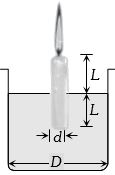
A candle of diameter $ d$ is floating on a liquid in a cylindrical container of diameter $D $  $(D>>d)$  as shown in figure. If it is burning at the rate of $2$ cm/hour then the top of the candle will
It is known that wax contracts on solidification. If molten wax is taken in a large vessel and it is allowed to cool slowly, then
A particle is moving in a circular path. The acceleration and momentum vectors at an instant of time are $\vec{a}=2 \hat{i}+3 \hat{j} m / s ^2$ and $\overrightarrow{ p }=6 \hat{ i } + 4 \hat{ j } kgm /$ $s$. Then the motion of the particle is
Consider the situation of the previous problem. The force on the central charge due to the shell is:
The $\text{COM}$ of body in pure rotation does-
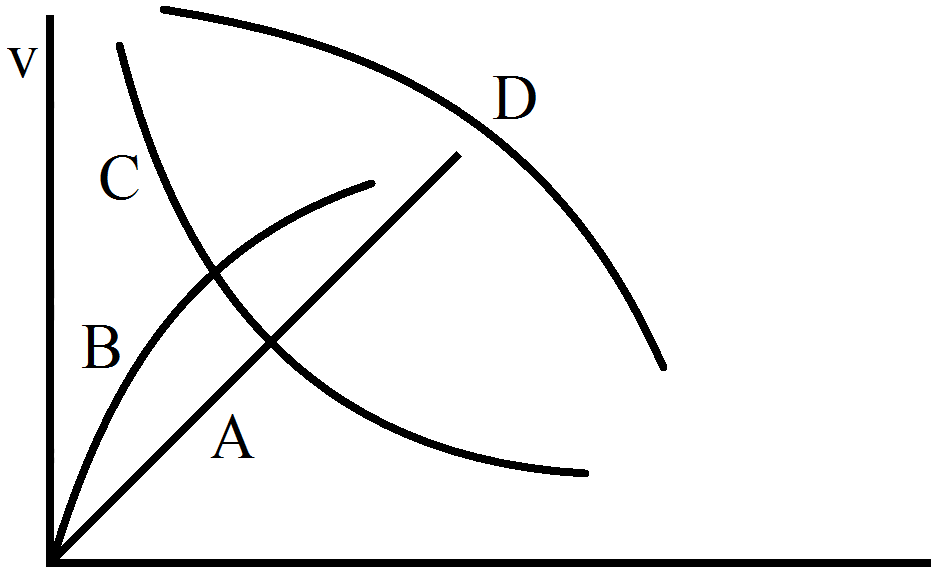
A spherical ball is dropped in a long column of a viscous liquid. The speed of the ball as a function of time may be best represented by the graph:
The area of cross-section of a wire of length $1.1$ metre is $1$ $mm^2$. It is loaded with $1 \,kg.$ If Young's modulus of copper is $1.1 \times {10^{11}}\,N/{m^2}$, then the increase in length will be ......... $mm$ (If $g = 10\,m/{s^2})$
Mass $M$ is divided into two parts $xM$ and $(1 - x)\,M$. For a given separation, the value of $x$ for which the gravitational attraction between the two pieces becomes maximum is
When stopping potential is applied in an experiment on photoelectric effect, no photocurrent is observed. This means that:
The pressure of air in a soap bubble of $0.7\,cm$ diameter is $8\, mm$ of water above the pressure outside. The surface tension of the soap solution is ........ $dyne/cm$