MCQ
The pressure of air in a soap bubble of $0.7\,cm$ diameter is $8\, mm$ of water above the pressure outside. The surface tension of the soap solution is ........ $dyne/cm$
  • A
    $100$
  • $68.66$
  • C
    $137$
  • D
    $150$

Answer

Correct option: B.
$68.66$
b
(b) $\Delta P = \frac{{4T}}{r} = hdg \Rightarrow T = \frac{{rhdg}}{4}$ $ = \frac{{0.35 \times 0.8 \times 1 \times {{10}^3}}}{4}$

$ = 70\;dyne/cm$$ \equiv 68.66\;dyne/cm$

Need a full question paper?

Generate a complete, print-ready paper with questions like this in minutes — across 16+ boards, with answer keys.

Start Generating Free

Similar questions

Apparatus used to find out the velocity of sound in gas is
In stretching a spring by $2\,cm$ energy stored is given by $U,$ then more stretching by $10\,cm$ energy stored will be
A boy of mass $20\, kg$ is standing on a $80\, kg$ free to move long cart. There is negligible friction between cart and ground. Initially, the boy is standing $25\, m$ from a wall. If he walks $10\, m$ on the cart towards the wall, then the final distance of the boy from the wall will be ........ $m$
A satellite of mass $m$ revolves around the earth of radius $R$ at a height $x$ from it's surface. If $g$ is the acceleration due to gravity on the surface of earth, the orbital speed of
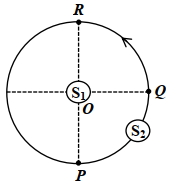
$S_1$ and $S_2$ are two identical sound sources of frequency $656 Hz$. The source $S_1$ is located at $O$ and $S_2$ moves anti-clockwise with a uniform speed $4 \sqrt{2} ms ^{-1}$ on a circular path around $O$, as shown in the figure. There are three points $P, Q$ and $R$ on this path such that $P$ and $R$ are diametrically opposite while $Q$ is equidistant from them. A sound detector is placed at point $P$. The source $S_1$ can move along direction $O P$.

[Given: The speed of sound in air is $324 ms ^{-1}$ ]

($1$) When only $S_2$ is emitting sound and it is $Q$, the frequency of sound measured by the detector in $Hz$ is. . . . . .

($2$) Consider both sources emitting sound. When $S_2$ is at $R$ and $S_1$ approaches the detector with a speed $4 ms ^{-1}$, the beat frequency measured by the detector is $\qquad$ $Hz$.
A thin and uniform rod of mass $M$ and length $L$ is held vertical on a floor with large friction. The rod is released from rest so that it falls by rotating about its contact-point with the floor without slipping. Which of the following statement($s$) is/are correct, when the rod makes an angle $60^{\circ}$ with vertical ? [ $g$ is the acceleration due to gravity]

$(1)$ The radial acceleration of the rod's center of mass will be $\frac{3 g }{4}$

$(2)$ The angular acceleration of the rod will be $\frac{2 g }{ L }$

$(3)$ The angular speed of the rod will be $\sqrt{\frac{3 g}{2 L}}$

$(4)$ The normal reaction force from the floor on the rod will be $\frac{ Mg }{16}$
If the current is doubled, the deflection is also doubled in:
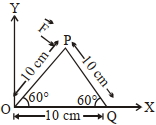
A triangular plate is shown. A force $\overrightarrow{ F }=4 \hat{ i }-3 \hat{ j }$ is applied at point $P$. The torque at point $P$ with respect to point $'O'$ and $'Q'$ are
$100 \,gm$ of ice at $0°C$ is mixed with $100\, g$ of water at $100°C.$ What will be the final temperature of the mixture .......... $^oC$
A particle projected from origin moves in $x-y$ plane with a velocity $\vec{v}=3 \hat{i}+6 x \hat{j}$, where $\hat{i}$ and $\hat{j}$ are the unit vectors along $x$ and $y$ axis. Find the equation of path followed by the particle