MCQ
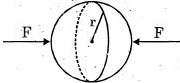
Two identical non-conducting thin hemispherical shells each of radius $R$ are  brought in contact to make a complete sphere . If a total charge $Q$ is uniformly distributed on them, how much minimum force $F$ will  be required to hold them together
  • A
    $F = \frac{{{Q^2}}}{{16\pi {\varepsilon _0}{R^2}}}$
  • $F = \frac{{{Q^2}}}{{32\pi {\varepsilon _0}{R^2}}}$
  • C
    $F = \frac{{{Q^2}}}{{64\pi {\varepsilon _0}{R^2}}}$
  • D
     $\frac{{{Q^2}}}{{32\pi {\varepsilon _0}{R^2}}} >F> \frac{{{Q^2}}}{{64\pi {\varepsilon _0}{R^2}}}$
Answer

Correct option: B.
$F = \frac{{{Q^2}}}{{32\pi {\varepsilon _0}{R^2}}}$
b
$\mathrm{F}=$ (Electric pressure) $\times$ (Projected area)

$=\frac{\sigma^{2}}{2 \varepsilon_{0}}\left(\pi r^{2}\right)=\left(\frac{Q}{4 \pi R^{2}}\right)^{2}\left(\frac{1}{2 \varepsilon_{0}}\right) \pi R^{2}$

$\left[ {\frac{{{{\rm{Q}}^2}}}{{32\pi {\varepsilon _0}{{\rm{R}}^2}}}} \right]$

Need a full question paper?

Generate a complete, print-ready paper with questions like this in minutes — across 16+ boards, with answer keys.

Start Generating Free

Similar questions

Demagnetisation of magnets can be done by
Using the expression $2 d \sin \theta=\lambda$, one calculates the values of $d$ by measuring the corresponding angles $\theta$ in the range $0$ to $90^{\circ}$. The wavelength $\lambda$ is exactly knowns and the error in $\theta$ is constant for all values of $\theta$. As $\theta$ increases from $0^{\circ}$ :
On $0^\circ C$ pressure measured by barometer is $760\, mm.$ What will be pressure on $100^\circ C$
Two particles of mass $m$ each are tied at the ends of a light string of length $2a$ . The whole system is kept on a frictionless horizontal surface with the string held tight so that each mass is at a distance $'a'$ from the centre $P$ (as shown in the figure). Now, the mid-point of the string is pulled vertically upwards with a small but constant force $F$ . As a result, the particles move towards each other on the surface. The magnitude of acceleration, when the separation between them becomes $2x$ , is
A satellite $S$ is moving in an elliptical orbit around the earth. The mass of the satellite is very small compared to the mass of earth
The graph which depicts the results of Rutherform gold foil experiment with $\alpha$ -particales is

$\theta:$ Scattering angle

$\mathrm{Y}:$ Number of scattered $\alpha$ -particles detected

(Plots are schematic and not to scale)

$X-$ rays region lies between
The linear mass density of a thin rod $A B$ of length $L$ varies from $A$ to $B$ as $\lambda( x )=\lambda_{0}\left(1+\frac{ x }{ L }\right),$ where $x$ is the distance from A. If $M$ is the mass of the rod then its moment of inertia about an axis passing through $A$ and perpendicular to the rod is$......ML^{2}$
In the $ n^{th} $ orbit, the energy of an electron ${E_n} = - \frac{{13.6}}{{{n^2}}}eV$ for hydrogen atom. The energy required to take the electron from first orbit to second orbit will be.....$eV$
A force of $200\, N$ is applied at one end of a wire of length $2\, m$ and having area of cross-section ${10^{ - 2}}\,c{m^2}$. The other end of the wire is rigidly fixed. If coefficient of linear expansion of the wire $\alpha = 8 \times 10{^{-6}}°C^{-1}$ and Young's modulus $Y = 2.2 \times {10^{11}}\,N/{m^2}$ and its temperature is increased by $5°C$, then the increase in the tension of the wire will be ........ $N$