MCQ
A radioactive element emits $200$ particles per second. After three hours $25$ particles per second are emitted. The half life period of element will be ..........$minntes$
  • A
    $50$
  • $60 $
  • C
    $70$
  • D
    $80$

Answer

Correct option: B.
$60 $
b
(b) $R = \frac{{dN}}{{dt}} \propto N$

$\Rightarrow \frac{{{R_2}}}{{{R_1}}} = \frac{{{N_2}}}{{{N_1}}}$

But $\frac{{{N_2}}}{{{N_1}}} = {\left( {\frac{1}{2}} \right)^{{t_{1/2}}}}$

$\Rightarrow \frac{{25}}{{200}} = \frac{1}{8} = {\left( {\frac{1}{2}} \right)^3}$

$\Rightarrow \frac{t}{{{t_{1/2}}}} = 3$ 

$\therefore {t_{1/2}} = \frac{t}{3} = \frac{3}{3} = 1\;hour = 60\,minutes$

Need a full question paper?

Generate a complete, print-ready paper with questions like this in minutes — across 16+ boards, with answer keys.

Start Generating Free

Similar questions

$A$ long solenoid of $N$ turns has a self inductance $L$ and area of cross section $A$. When a current $i$ flows through the solenoid, the magnetic field inside it has magnitude $B$. The current $i$ is equal to:
An electron having mass $m$ and kinetic energy $K$ enter in uniform magnetic field $B$ perpendicularly, then its frequency will be
How can the brightness of the pattern on the screen of cathode ray tube be changed?
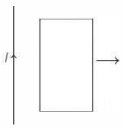
A rectangular loop of wire shown below is coplanar with a long wire carrying current $I$. The loop is pulled to the right a s indicated. What are the directions of the induced current in the loop and the magnetic forces on the left and the right sides of the loop?
  Induced current Force on left side Force on right side
$a.$ Counter clockwise To the left To the right
$b.$ clockwise To the left To the right
$c.$ Counter clockwise To the right To the left
$d.$ clockwise To the right To the left

Two charges of magnitude $+ q$ and $-\,3q$ are placed $100\,cm$ apart. The distance from $+ q$ between the charges where the electrostatic potential is zero is.......$cm$
Mark the correct options:
If an electron enters a magnetic field with its velocity pointing in the same direction as the magnetic field, then
The photoelectric work function for a metal surface is 4.125 eV. The cut-off wavelength for this surface is
Kirchoff's first law, i.e., $\sum\text{i}=0$ at a junction, deals with the conservation of:
White light may be considered to be a mixture of waves with $\lambda$ ranging between $4000 Å, 4667 Å, 5600 Å, 7000 Å, 3900 Å$ and  $  7800 Å$. An oil film of thickness $10,000 Å$ is examined normally by reflected light. If $\mu  = 1.4$, then the film appears bright for