Question
  1. A radioactive nucleus 'A' undergoes a series of decays as given below:
$\text{A}\xrightarrow\alpha\text{A}_1\xrightarrow\beta\text{A}_2\xrightarrow\alpha\text{A}_3\xrightarrow\gamma\text{A}_4$

The mass number and atomic number of $A_2$ are 176 and 71 respectively. Determine the mass and atomic numbers of $A_4$ and A.
  1. Write the basic nuclear process underlying $\beta+$ and $\beta-$ decays.
Answer

$\text{A}^{180}_{74}\xrightarrow\alpha\text{A}^{176}_{72}\xrightarrow\beta\text{A}^{176}_{71}\xrightarrow\alpha\text{A}^{172}_{69}\xrightarrow\gamma\text{A}^{172}_{69}$
The mass number and atomic number of $A_4$ is 172 and 69, respectively.
The mass number and atomic number of A is 180 and 74, respectively.
Basic process underlying $\beta+$ and $\beta-$ decay are
During a weak interaction an atomic nucleus converts into a nucleus with one higher atomic number while emitting one electron and an electron antineutrino this is called beta minus decay.
$X^A_Z\rightarrow Y^A_{Z+1}+e^-+\bar{ve}$
During a weak interaction an atomic nucleus converts into a nucleus with one lower number while emitting a positron and electron neutrino this is called beta Plus decay.
$X^A_Z\rightarrow Y^A_{Z-1}+e^++\bar{ve}$

Need a full question paper?

Generate a complete, print-ready paper with questions like this in minutes — across 16+ boards, with answer keys.

Start Generating Free

Similar questions

A small telescope has an objective lens of focal length 140 cm and an eyepiece of focal length 5.0 cm. What is the magnifying power of the telescope for viewing distant objects when,
  1. the telescope is in normal adjustment (i.e., when the final image is at infinity)?
  2. the final image is formed at the least distance of distinct vision (25 cm)?
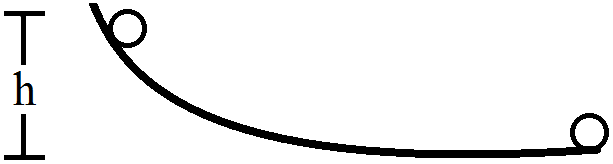
A small spherical ball is released from a point at a height h on a rough track shown in figure. Assuming that it does not slip anywhere, find its linear speed when it rolls on the horizontal part of the track.
Suppose the bob of the previous problem has a speed of 1.4m/ s when the string makes an angle of 0.20 radian with the vertical. Find the tension at this instant. You can use $\cos\theta\approx1-\frac{\theta^2}{2}$ and $\sin\theta\approx\theta$ for small $\theta.$
Explain two  main important points for astronomical telescope.
Find the energy liberated in the reaction:
$^{223}Ra → ^{209}Pb + ^{14}C.$
The atomic masses needed are as follows.
$^{223}Ra$ $^{209}Pb$ $^{14}C$
$22.018u$ $208.981u$ $14.003u$
A thin prism is made of a material having refractive indices 1.61 and 1.65 for red and violet light. The dispersive power of the material is 0.07. It is found that a beam of yellow light passing through the prism suffers a minimum deviation of 4.0° in favourable conditions. Calculate the angle of the prism.
A point object is placed on the principal axis of a convex lens (f = 15cm) at a distance of 30cm from it. A glass plate $(\mu=1.50)$ of thickness 1cm is placed on the other side of the lens perpendicular to the axis. Locate the image of the point object.
A piece of wire carrying a current of 6.00A is bent in the form of a circular arc of radius 10.0cm, and it subtends an angle of 120° at the centre. Find the magnetic field B due to this piece of wire at the centre.
Explain, with the help of a schematic diagram, the principle and working of a Light Emitting Diode. What criterion is kept in mind while choosing the semiconductor material for such a device? Write any two advantages of Light Emitting Diode over conventional incandescent lamps.
A body stretches a spring by a particular length at the earth's surface at equator. At what height above the south pole will it stretch the same spring by the same length? Assume the earth to be spherical.