Question
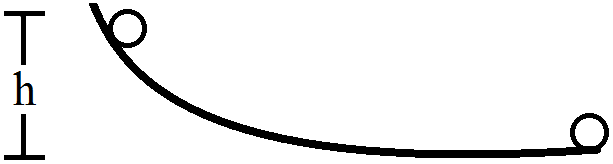
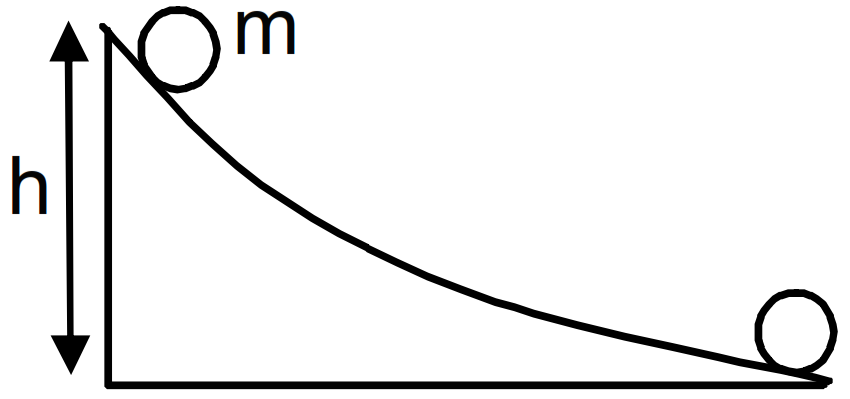
A small spherical ball is released from a point at a height h on a rough track shown in figure. Assuming that it does not slip anywhere, find its linear speed when it rolls on the horizontal part of the track.
Answer

A small spherical ball is released from a point at a height on a rough track & the sphere does not slip. Therefore potential energy it has gained w.r.t the surface will be converted to angular kinetic energy about the centre & linear kinetic energy. Therefore $\text{mgh}=\Big(\frac{1}{2}\Big)\text{l}\omega^2=\Big(\frac{1}{2}\Big)\text{mv}^2$$\Rightarrow\text{mgh}=\frac{1}{2}\times\frac{2}{5} \text{mR}^2\omega^2+\Big(\frac{1}{2}\Big)\text{mv}^2$
$\Rightarrow\text{gh}=\frac{1}{5}\text{v}^2+\frac{1}{2}\text{v}^2$
$\Rightarrow\text{v}^2=\frac{10}{7}\text{gh}$
$\Rightarrow\text{v}=\sqrt{\frac{10}{7}\text{gh}}$

Need a full question paper?

Generate a complete, print-ready paper with questions like this in minutes — across 16+ boards, with answer keys.
Start Generating Free

Similar questions

The density of an ideal gas is $1.25 \times 10^{-3}gcm^3$ at STP. Calculate the molecular weight of the gas.
A block is projected along a rough horizontal road with a speed of 10m/s. If the coefficient of kinetic friction is 0.10, how far will it travel before coming to rest?
A body stretches a spring by a particular length at the earth's surface at equator. At what height above the south pole will it stretch the same spring by the same length? Assume the earth to be spherical.
Write the definition of wavefront. Using Huygens' principle, draw the shape of a plane wave incident on a convex lens and the refracted wave body.
###
(a) When a wave propagates from a rarer medium to a denser medium, then which characteristic of that wave does not change and why?
(b) The refractive indices of two mediums are $\mu_1$ and $\mu_2$, what will be the ratio of velocities in the wave in them?
It is sometimes heard that inertial frame of reference is only an ideal concept and no such inertial frame actually exists. Comment.
A charged particle enters into a uniform magnetic field and experiences an upward force as indicated in the figure. What is the charge sign on the particle?
What is the de Broglie wavelength of:
  1. A bullet of mass 0.040 kg travelling at the speed of 1.0 km/s,
  2. A ball of mass 0.060 kg moving at a speed of 1.0 m/s, and
  3. A dust particle of mass $1.0 \times 10^{–9} kg$ drifting with a speed of 2.2 m/s?
The following circuit shows the use of potentiometer to measure the internal resistance of a cell:
  1. When the key is open, how does the balance point change, if the current from the driver cell decreases?
  2. When the key K is closed, how does the balance point change if R is increased keeping current from the driver cell constant?
A swimmer wishes to cross a 500m wide river flowing at 5km/h. His speed with respect to water is 3km/h.
  1. If he heads in a direction making an angle 0 with the flow, find the time he takes to cross the river.
  2. Find the shortest possible time to cross the river.
A carrom board (4ft × 4ft square) has the queen at the centre. The queen, hit by the striker moves to the front edge, rebounds and goes in the hole behind the striking line. Find the magnitude of displacement of the queen:
  1. From the centre to the front edge.
  2. From the front edge to the hole.
  3. From the centre to the hole.