Question

A ray passes through a prism of angle 60° in minimum deviation position and suffers a deviation of 30°. What is the angle of incidence on the prism

(a) 30°

(b) 45°

(c) 60°

(d) 90°

Answer

(b) 45°

Need a full question paper?

Generate a complete, print-ready paper with questions like this in minutes — across 16+ boards, with answer keys.

Start Generating Free

Similar questions

A torch battery consisting of two cells of 1.45 volts and an internal resistance 0.15Ω, each cell sending currents through the filament of the lamps having resistance 1.5ohms. The value of current will be

(a) 16.11 amp

(b) 1.611 amp

(c) 0.1611 amp

(d) 2.6 amp

A far sighted man who has lost his spectacles, reads a book by looking through a small hole (3-4 mm) in a sheet of paper. The reason will be

(a) Because the hole produces an image of the letters at a longer distance 

(b) Because in doing so, the focal length of the eye lens is effectively increased 

(c)  Because in doing so, the focal length of the eye lens is effectively decreased

(d) None of these

The coefficient of self inductance and the coefficient of mutual inductance have.
Which principle suggests that the intensity of light determines its amplitude?
How are the field lines in a uniform magnetic field ?
Consider the following two statements:
  1. Line spectra contain information about atoms.
  2. Band spectra contain information about molecules.
  1. Both A and B are wrong
  2. A is correct but B is wrong.
  3. B is correct but A is wrong
  4. Both A and B are correct.

There is no atmosphere on moon because

(a) There is no vegetation

(b) The escape velocity at its surface is very low

(c) Diffusion constant of gases is high

(d) There is vacuum in space

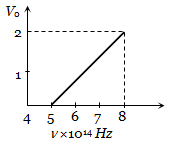
The stopping potential (  versus frequency (n) plot of a substance is shown in figure the threshold wave length is

(a) 5

(b) 6000Å

(c) 5000 Å

(d) Can not be estimated from given data

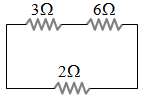
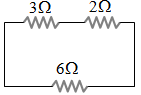
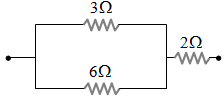
If you are provided three resistances 2 W, 3 W and 6 W. How will you connect them so as to obtain the equivalent resistance of 4 W

(a)

(b)

(c)

(d) None of these

There is no couple acting when two bar magnets are placed coaxially separated by a distance because

(a) There are no forces on the poles

(b) The forces are parallel and their lines of action do not coincide

(c) The forces are perpendicular to each other

(d) The forces act along the same line