MCQ
A reaction involving two different reactants
  • A
    Can never be a second order reaction
  • Can never be a unimolecular reaction
  • C
    Can never be a bimolecular reaction
  • D
    Can never be a first order reaction

Answer

Correct option: B.
Can never be a unimolecular reaction
b
(b)Because two molecules are taking part in elementary step.

Need a full question paper?

Generate a complete, print-ready paper with questions like this in minutes — across 16+ boards, with answer keys.

Start Generating Free

Similar questions

$K_1 , K_2$ and $K_3$ are the equilibrium constants of the following reactions $(I), (II)$ and $(III)$ respectively

$(I)\,\,\,\,{N_2} + 2{O_2} \rightleftharpoons 2N{O_2}$

$(II)\,\,\,\,2N{O_2} \rightleftharpoons {N_2} + 2{O_2}$

$(III)\,\,\,\,N{O_2} \rightleftharpoons \frac{1}{2}{N_2} + 2{O_2}$

The correct relation from the following is
Both ionic and covalent bond is present in the following
A complex containing $K^+, Pt(IV)$ and $Cl^-$ is $100\%$ ionised giving $i = 3$. Thus,  possible complex is 
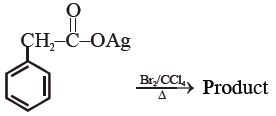
In following reaction major product will be
The rate of a reaction is doubled for every ${10\,^o}$ rise in temperature. The increase in reaction rate as a result of temperature rise from ${10\,^o}$ to ${100\,^o}$ is
Give the correct of initials $T$ or $F$ for following statements. Use $T$ if  statement is true and $F$ if it is false.

$(I)\, Co(III)$ is stabilised in presence of weak field ligands, while $Co(II)$ is  stabilised in presence of strong field ligand. 

$(II)$ Four coordinated complexes of $Pd(II)$ and $Pt(II)$ are diamagnetic and  square planar.

$(III)\,[Ni (CN)_4]^{4-}$ ion and $[Ni (CO)_4]$ are diamagnetic tetrahedral and  square planar respectively. 

$(IV)\,Ni^{2+}$ ion does not form inner orbital octahedral complexes.

The electronic configuration (outermost) of $M{n^{ + 2}}$ ion (atomic no. of $Mn = 25$) in its ground state is
Which is not similar characteristic $(s)$ about the electronic configuration of $Be, Mg, Ca$?
Ethylene reacts with Baeyer's reagent to give
All but one of the following compounds react with aniline to give acetanilide.  Which one does not?