Question
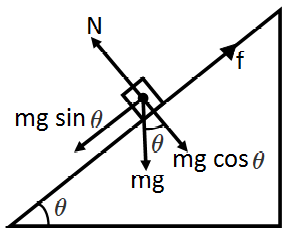
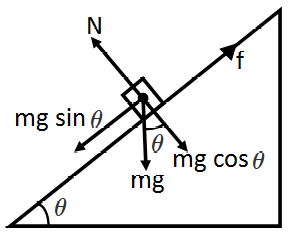
A rectangular box lies on a rough inclined surface. The coefficient of friction between the surface and the box is $\mu$. Let the mass of the box be m.
  1. At what angle of inclination $\theta$ of the plane to the horizontal will the box just start to slide down the plane?
  2. What is the force acting on the box down the plane, if the angle of inclination of the plane is increased to a $\theta>$?
  3. What is the force needed to be applied upwards along the plane to make the box either remain stationary or just move up with uniform speed?
  4. What is the force needed to be applied upwards along the plane to make the box move up the plane with acceleration a?
Answer

  1. As the box just start to slide down the plane then $\mu=\tan\theta$ (by angle of repose) $\theta-\tan^{-1}(\mu)$
  2. If angle$\alpha>\theta$ the angle of inclination of the plane with horizontal it will slide down (f upward) as $\theta$ is the angle of repose. So net force downward

$\text{F}_1=\text{mg}\sin\alpha-\text{f}=\text{mg}\sin\alpha-\mu\text{N}.$

$=\text{mg}\sin\alpha-\mu\ \text{mg}\cos\alpha$

$\text{F}_1=\text{mg}[\sin\alpha-\mu\cos\alpha]$

  1. To keep the box either stationary or just move it up with uniform velocity (1 =0)upward  (f downward)

$\text{F}_2-\text{mg}\sin\alpha-\text{f}=\text{ma}$

or $\text{F}_2-\text{mg}\sin\alpha-\mu\text{N}=0(\because\text{a}=0)$

$\text{F}_2=\text{mg}\sin\alpha-\mu\text{N}=0$

$\text{F}_2=\text{mg}(\sin\alpha-\mu\cos\alpha)$

  1. The force applied $\text{F}_2$ to move the box upward with acceleration a

$\text{F}_3-\text{mg}\sin\alpha-\mu\cos\alpha=\text{ma}$

$\therefore\text{F}_3=\text{mg}(\sin\alpha+\mu\cos\alpha)+\text{ma}$

Need a full question paper?

Generate a complete, print-ready paper with questions like this in minutes — across 16+ boards, with answer keys.

Start Generating Free

Similar questions

Explain in detail the Kepler's three laws related to planetary motion.
Two identical balls A and B undergo a perfectly elastic two dimensional collision. Initially A is moving with a speed of 10ms-1 and B is at rest. Due to collision A is scattered through angle of 30°. What are the speed of A and B after the collision?
What is the effect of rotation on the value of 'g'? Derive the relation.
The molecules of a given mass of a gas have root mean square speeds of 1 100ms− at 27C ° and 1.00 atmospheric pressure. What will be the root mean square speeds of the molecules of the gas at 127°C and 2.0 atmospheric pressure?
A bullet of mass 10g moving horizontally at a speed of 5017m/s strikes a block of mass 490g kept on a frictionless track as shown in figure. The bullet remains inside the block and the system proceeds towards the semicircular track of radius 0.2m. Where will the block strike the horizontal part after leaving the semicircular track ?

A player throws a ball upwards with an initial speed of $29.4$ $m s ^{-1}$.
(a) What is the direction of acceleration during the upward motion of the ball?
(b) What are the velocity and acceleration of the ball at the highest point of its motion?
(c) Choose the $x = 0 ~ m$ and $t = 0 ~ s$ to be the location and time of the ball at its highest point, vertically downward direction to be the positive direction of $x$-axis, and give the signs of position, velocity and acceleration of the ball during its upward, and downward motion.
(d) To what height does the ball rise and after how long does the ball return to the player's hands?
(Take $g =9.8 ms^{-2}$ and neglect air resistance.)
Write Hooke's law. On what does the value of co-efficient of elasticity depend? Draw a graph between stress and strain with in the elastic limit.###Write Hooke's law. How to determine the coefficient of elasticity of a material of wire in the laboratory? Explain. Make necessary diagram also Compare the Young's Modulus of elasticity of different material.
Figure shows two parallel plate capacitors with fixed plates and connected to two batteries. The separation between the plates is the same for the two capacitors. The plates are rectangular in shape with width b and lengths l1 and l2 The left half of the dielectric slab has a dielectric constant K1 and the right half K2. Neglecting any friction, find the ratio of the emf of the left. battery to that of the right battery for which the dielectric slab may remain in equilibrium.

An ammeter is to be constructed that can read currents up to 2.0A. If the coil has resistance of $25\Omega$ and takes 1mA for full-scale deflection, what should be the resistance of the shunt used?
The current in a discharging LR circuit without the battery drops from 2.0A to 1.0A in 0.10s.
  1. Find the time constant of the circuit.
  2. If the inductance of the circuit is 4.0H, what is its resistance?