Question
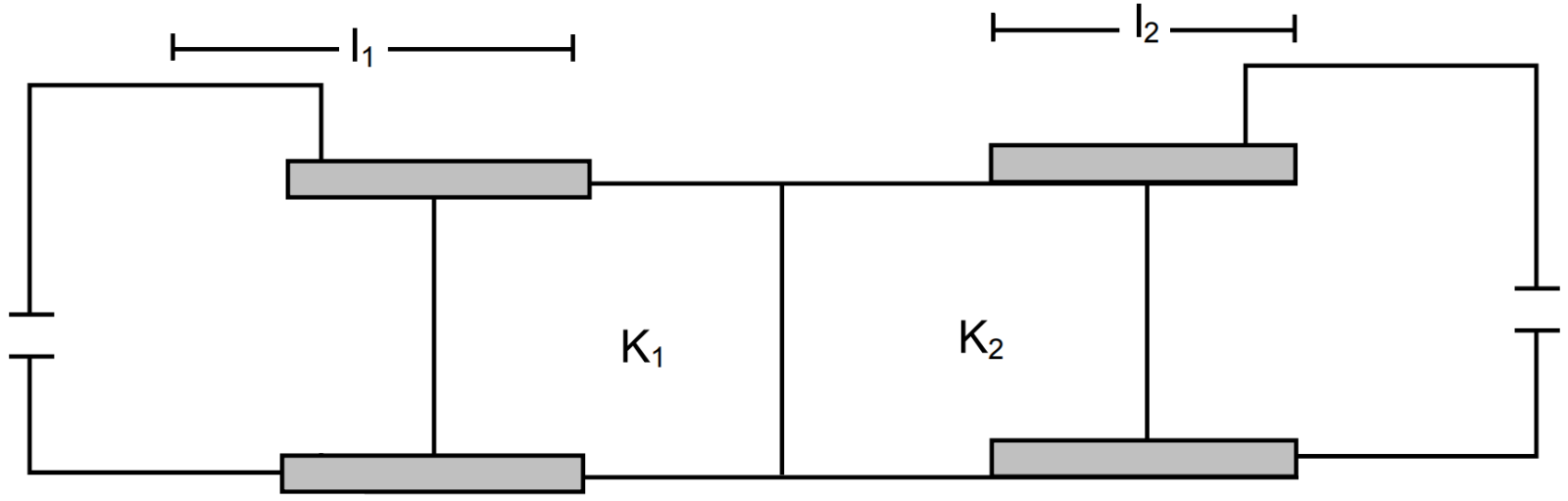
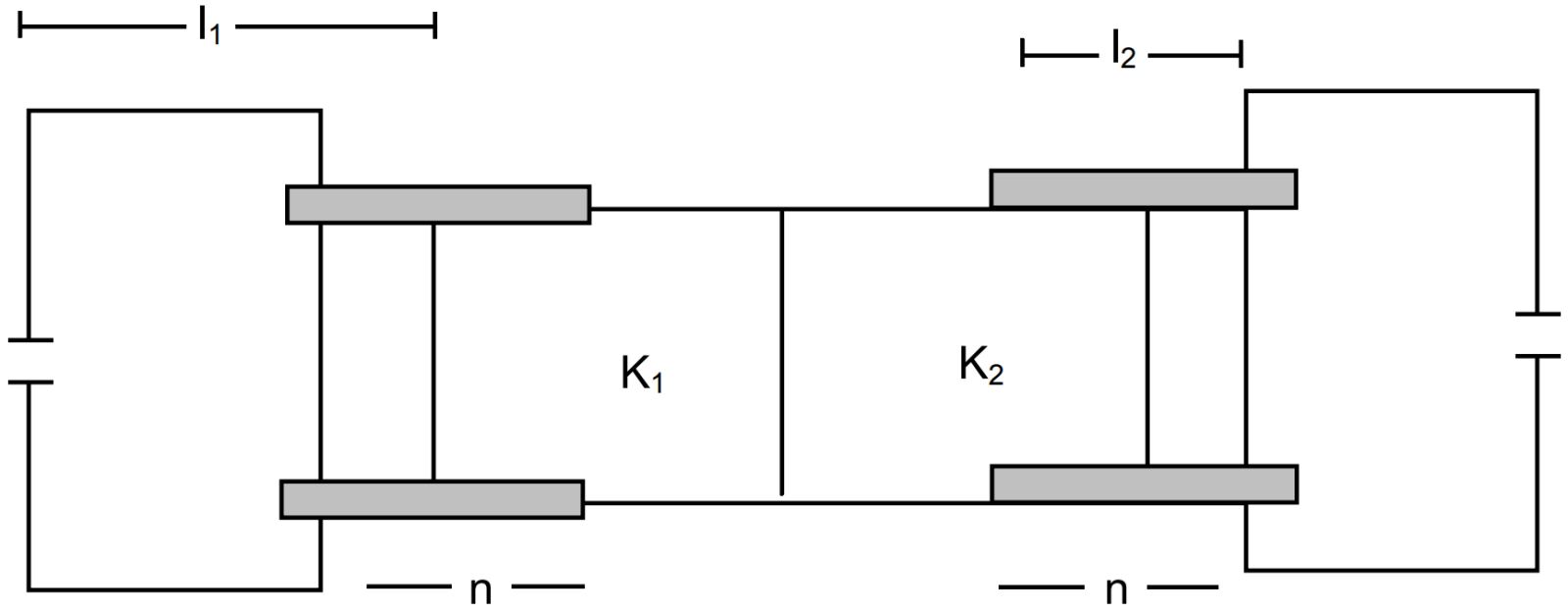
Figure shows two parallel plate capacitors with fixed plates and connected to two batteries. The separation between the plates is the same for the two capacitors. The plates are rectangular in shape with width b and lengths l1 and l2 The left half of the dielectric slab has a dielectric constant K1 and the right half K2. Neglecting any friction, find the ratio of the emf of the left. battery to that of the right battery for which the dielectric slab may remain in equilibrium.
Answer

Consider the left side

The plate area of the part with the dielectric is by its capacitance $\text{C}_1=\frac{\text{K}_1\in_0\text{bx}}{\text{d}}$ and with out dielectric $\text{C}_2=\frac{\in_0\text{b}(\text{L}_1-\text{x})}{\text{d}}$
These are connected in parallel

$\text{C}=\text{C}_1+\text{C}_2$

$=\frac{\in_0\text{b}}{\text{d}}[\text{L}_1+\text{x}(\text{k}_1-1)]$

Let the potential V1

$\text{U}=\Big(\frac{1}{2}\Big)\text{CV}_1^2=\frac{\in_0\text{bv}_1^2}{2\text{d}}[\text{L}_1+\text{x}(\text{k}-1)]\ \dots(1)$

Suppose dielectric slab is attracted by electric field and an external force F consider the part dx which makes inside further, As the potential difference remains constant at V.

The charge supply, dq = (dc)v to the capacitor.

The work done by the battery is dwb = v.dq = (dc)v2

The external force F does a work dwe = (–f.dx) during a small displacement.

The total work done in the capacitor is dwb + dwe = (dc)v2 - fdx

This should be equal to the increase dv in the stored energy.

Thus $\Big(\frac{1}{2}\Big)(\text{dk})\text{v}^2=(\text{dc})\text{v}^2-\text{fdx}$

$\text{f}=\frac{1}{2}\text{v}^2\frac{\text{dc}}{\text{dx}}$

from equation (1)

$\text{F}=\frac{\in_0\text{bv}^2}{2\text{d}}(\text{k}_1-1)$

$\Rightarrow\text{V}_1^2=\frac{\text{F}\times2\text{d}}{\in_0\text{b}(\text{k}_1-1)}$

$\Rightarrow\text{V}_1=\sqrt{\frac{\text{F}\times2\text{d}}{\in_0\text{b}(\text{k}_1-1)}}$

For the right side, $\text{V}_2=\sqrt{\frac{\text{F}\times2\text{d}}{\in_0\text{b}(\text{k}_2-1)}}$

$\frac{\text{V}_1}{\text{V}_2}=\frac{\sqrt{\frac{\text{F}\times2\text{d}}{\in_0\text{b}(\text{k}_1-1)}}}{\sqrt{\frac{\text{F}\times2\text{d}}{\in_0\text{b}(\text{k}_2-1)}}}$

$\frac{\text{V}_1}{\text{V}_2}=\frac{\sqrt{\text{k}_2-1}}{\sqrt{\text{k}_1-1}}$

$\therefore$ The ratio of the emf of the left battery to the right battery $=\frac{\sqrt{\text{k}_2-1}}{\sqrt{\text{k}_1-1}}$

Need a full question paper?

Generate a complete, print-ready paper with questions like this in minutes — across 16+ boards, with answer keys.

Start Generating Free

Similar questions

Define surface tension and surface energy. Write units and dimensions of surface tension. Also prove that surface energy numerically equal to the surface tension.
Explain linear simple harmonic motion by taking an example. Find the expression for its period and explain its dependence.
A motor car moving at a speed of 72km/h can not come to a stop in less than 3.0s while for a truck this time interval is 5.0s. On a higway the car is behind the truck both moving at 72km/h. The truck gives a signal that it is going to stop at emergency. At what distance the car should be from the truck so that it does not bump onto (collide with) the truck. Human response time is 0.5s.
Six point masses of mass m each are at the vertices of a regular hexagon of side l. Calculate the force on any of the masses.
A wire stretched between two rigid supports vibrates in its fundamental mode with a frequency of 45Hz. The mass of the wire is 3.5 × 10⁻²kg and its linear mass density is 4.0 × 10⁻²kg m–1. What is
  1. The speed of a transverse wave on the string,
  2. The tension in the string?
The temperature and humidity of air are 27°C and 50% on a particular day. Calculate the amount of vapour that should be added to 1 cubic metre of air to saturate it. The saturation vapour pressure at 27°C = 3600Pa.
A block of mass 2.0kg kept at rest on an inclined plane of inclination 37° is pulled up the plane by applying a constant force of 20N parallel to the incline. The force acts for one second.
  1. Show that the work done by the applied force does not exceed 40J.
  2. Find the work done by the force of gravity in that one second if the work done by the applied force is 40J.
  3. Find the kinetic energy of the block at the instant the force ceases to act. Take g = 10m/s2.
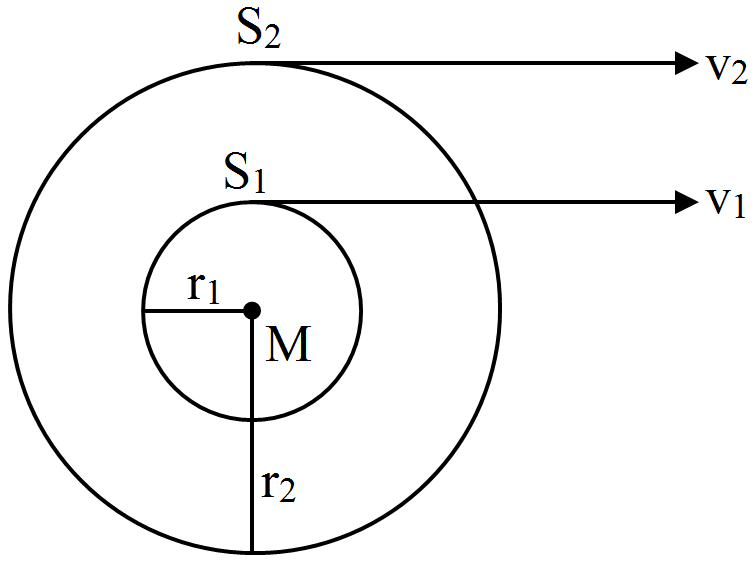
Two satellites S1 and S2 revolve round a planet in coplanar circular orbit in the same sense. Their periods of revolution are one hour and 8 hours respectively. The radius of the orbit of S1 is 104km. When S2 is close to S1 find:
  1. The speed of S2 relative to S1.
  2. The angular speed of S2 as actually observed by an astronaut in S1.

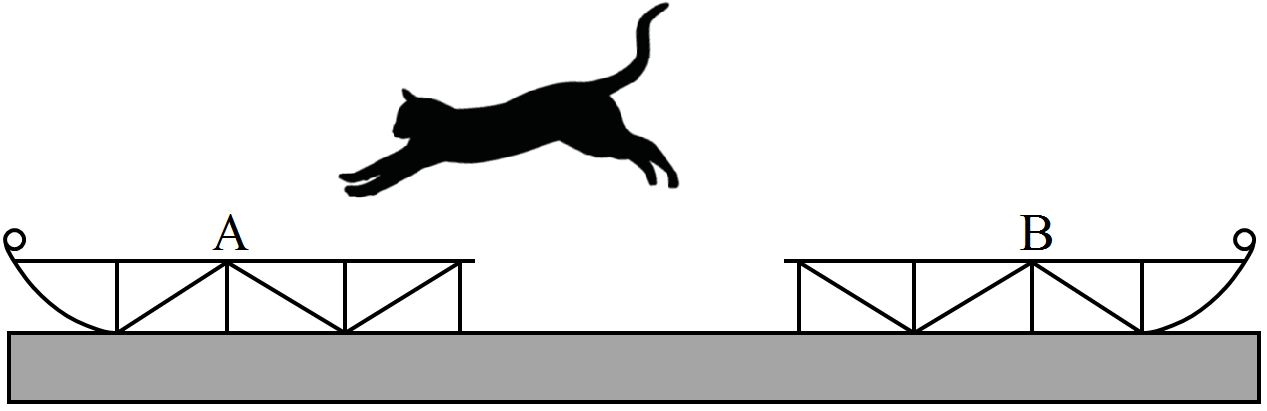
Two 22.7kg ice sleds A and B are placed a short distance apart, one directly behind the other, as shown in Fig. A 3.63kg cat, standing on one sled, jumps across to the other and immediately back to the first. Both jumps are made at a speed of 3.05ms-1 relative to the ice. Find the final speeds of the two sleds.

Answer the following:
What is the temperature of the triple-point of water on an absolute scale whose unit interval size is equal to that of the Fahrenheit scale?